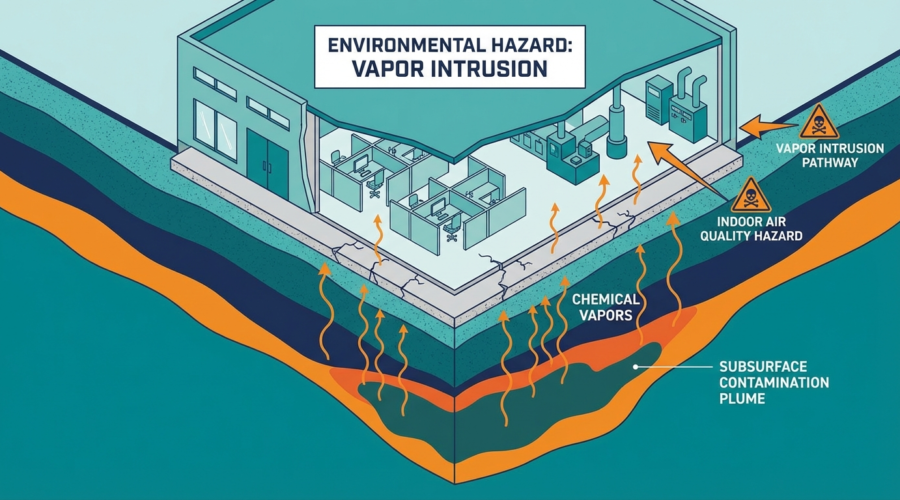
The contamination isn’t in the soil you can see. It isn’t in the groundwater you can test from a monitoring well. It’s in the air space beneath the concrete slab of the building your employees walk into every morning — migrating upward through foundation cracks, utility penetrations, and the pressure differential between the soil gas below and the conditioned air above.
Vapor intrusion is one of the least understood and most consequential environmental conditions in DFW commercial real estate. It affects a significant number of properties in the Metroplex — particularly in areas with historical industrial land use where chlorinated solvents or petroleum hydrocarbons were released to the subsurface decades ago. And it’s a condition that conventional Phase I and Phase II practice frequently fails to adequately characterize.
This post explains what vapor intrusion is, why DFW commercial properties are at elevated risk, how the pathway is evaluated, and what options exist when it’s identified.
What Vapor Intrusion Is
The Pathway Mechanism
Vapor intrusion is the migration of volatile chemicals from contaminated soil or groundwater into the air space of overlying structures. The mechanism is analogous to radon — a naturally occurring radioactive gas that also enters buildings through the same pathway — but involves man-made contaminants, typically volatile organic compounds (VOCs) from industrial or commercial operations.
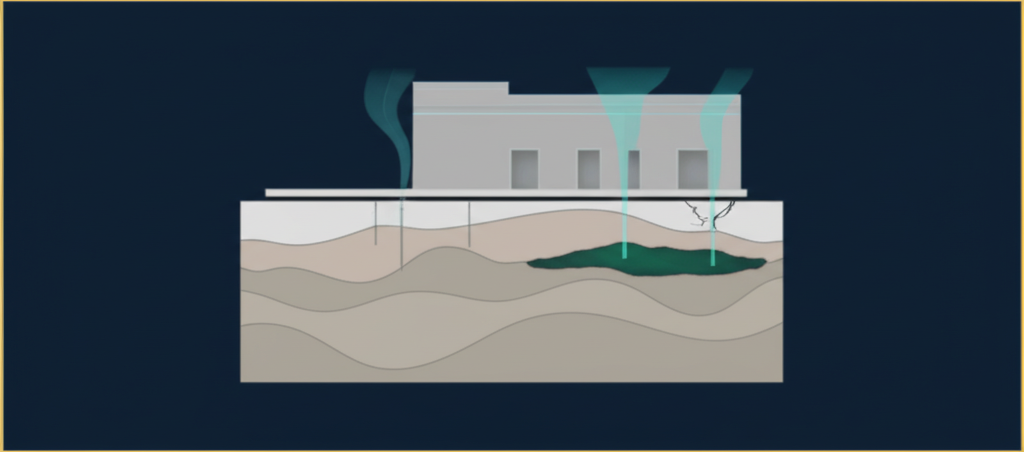
The driving force for vapor intrusion is a combination of:
- Concentration gradient: High concentrations of volatile compounds in subsurface soil gas create a gradient toward lower-concentration indoor air
- Pressure differential: Buildings are typically at slightly negative pressure relative to outdoor air due to HVAC systems, thermal stack effects, and wind effects — this creates a “chimney effect” that draws soil gas upward through foundation openings
- Preferential pathways: Utility conduits, foundation cracks, sump pits, floor drains, and other penetrations through the foundation slab provide low-resistance pathways for soil gas to enter the building
The result is that indoor air in buildings overlying or downgradient of volatile contaminant sources can contain elevated concentrations of those contaminants — potentially at levels that exceed occupational health guidelines or EPA’s cancer risk benchmarks — without any visible indication of a problem at the surface.
Chemicals of Concern for Vapor Intrusion
Not all contaminants present a vapor intrusion risk. The chemicals most significant for vapor intrusion are those that are both volatile (they readily partition from soil or groundwater into gas phase) and toxic at low concentrations. The primary vapor intrusion chemicals of concern at DFW commercial and industrial properties are:
- Trichloroethylene (TCE): A chlorinated solvent used extensively in metal degreasing, parts cleaning, and manufacturing. TCE is a known human carcinogen (Group 1 classification under IARC) and has one of the lowest vapor intrusion screening levels of any industrial chemical. EPA’s current reference concentration for inhalation is 2 μg/m³ — an extremely low number that means even modest vapor intrusion of TCE can produce indoor air concentrations above acceptable risk levels.
- Tetrachloroethylene (PCE): The primary dry cleaning solvent. Former dry cleaning facilities are present throughout DFW’s older commercial corridors — Greenville Avenue, Henderson Avenue, Garland Road, Main Street corridors in suburban cities — and PCE contamination in shallow groundwater beneath or adjacent to these former operations creates a vapor intrusion pathway for any overlying or downgradient occupied building.
- Benzene: The most toxicologically significant component of petroleum fuel releases. While less volatile than chlorinated solvents, benzene in shallow groundwater at elevated concentrations can produce vapor intrusion at levels exceeding EPA cancer risk guidelines. TCEQ LPST case closures frequently evaluate the vapor intrusion pathway through sub-slab vapor sampling requirements.
- Vinyl Chloride: The terminal degradation product of TCE and PCE under anaerobic conditions in groundwater. Vinyl chloride is both more volatile and more carcinogenic than its parent compounds, and its formation from slowly degrading chlorinated solvent plumes means that contamination that began as TCE or PCE may have evolved, over decades of natural degradation, into a vinyl chloride dominated plume with a more aggressive vapor intrusion signature.
- 1,4-Dioxane: A co-solvent stabilizer used in some formulations of 1,1,1-trichloroethane (TCA). 1,4-Dioxane doesn’t adsorb to soil and travels ahead of TCE/TCA plumes in groundwater. It’s also more difficult to remediate than most chlorinated solvents. Its vapor intrusion characteristics differ from the primary solvents, and it’s increasingly evaluated as a separate compound at multi-contaminant sites.
Why DFW Commercial Properties Are at Elevated Risk
The Industrial Legacy of the Metroplex
Dallas-Fort Worth’s industrial development patterns created conditions for widespread subsurface contamination that is only now being fully characterized, decades after the releases occurred. The relevant history includes:
- Defense and aerospace manufacturing: DFW was a significant defense manufacturing hub during and after World War II. Facilities in Grand Prairie, Arlington, Fort Worth, and Dallas produced aircraft, electronics, and defense components using chlorinated solvents extensively. TCE was the industry-standard metal degreasing solvent in virtually all metalworking operations through the 1980s.
- Auto repair and light industrial corridors: The Metroplex’s older commercial strips — developed in the 1950s through 1970s — included high concentrations of auto repair shops, machine shops, and light manufacturing operations that used chlorinated solvents and petroleum products. Many of these operations are gone, but their chemical legacy remains in the subsurface beneath properties that have since been redeveloped for retail, office, or light industrial use.
- Dry cleaning industry: Virtually every established DFW neighborhood had at least one dry cleaner, and most of those dry cleaners used perchloroethylene. The industry’s standard disposal practices — pouring spent solvent and separator water through floor drains or into nearby drainage areas — created thousands of small-scale PCE release sites throughout the Metroplex. Many of those former dry cleaning locations now underlie grocery stores, strip malls, and professional office buildings.
- Former railroad corridors: DFW’s extensive historical rail network included maintenance facilities, fueling stations, and rail yards where petroleum products and chlorinated solvents were used. The city of Dallas in particular has multiple documented chlorinated solvent plumes associated with former railroad operations.
DFW Geology and Vapor Intrusion Risk
The geological setting of DFW affects vapor intrusion risk in ways that are not always intuitive. The key geological factors include:
- Shallow groundwater depth in some areas: Where the water table is within 10-15 feet of the surface — common in alluvial settings along DFW’s creek and river corridors — dissolved-phase contaminants are in proximity to the foundation, and vapor-phase concentrations in the shallow vadose zone can be high. The shorter the vertical distance between contaminated groundwater and the building foundation, the higher the vapor intrusion potential.
- Austin Chalk fracture networks: In north Dallas and the northern Metroplex suburbs, the Austin Chalk’s well-developed fracture network can transmit soil gas rapidly over relatively large distances. Vapor-phase contamination in Austin Chalk fractures doesn’t behave like diffusion through a homogeneous soil matrix — it can migrate preferentially along fractures in ways that make standard vapor intrusion attenuation models non-conservative.
- Eagle Ford Clay as a partial barrier — but not a complete one: The low-permeability Eagle Ford clay that underlies much of the western Metroplex is sometimes cited as a barrier to vapor migration. While clay does retard vapor diffusion relative to sandier soils, it is not impermeable to vapor transport — particularly where the clay has developed shrinkage cracks or macro-pore networks. Eagle Ford clay reduces but does not eliminate vapor intrusion risk.
How Vapor Intrusion Is Evaluated
The Conceptual Site Model
Vapor intrusion evaluation begins with a Conceptual Site Model (CSM) that integrates information about:
- The nature and distribution of volatile contaminants in subsurface soil and groundwater
- The depth to groundwater and the vadose zone thickness
- The physical characteristics of the overlying building (foundation type, slab thickness and condition, HVAC configuration, basement or crawl space presence)
- The occupancy and use pattern of the building (office, retail, industrial — which determines both exposure duration and receptor characteristics)
- Preferential migration pathways (utility conduits, sump pits, foundation openings)
The CSM drives the sampling strategy. A building with a thick concrete slab on grade in an industrial setting has a very different vapor intrusion risk profile than an older commercial building with a thin slab, multiple utility penetrations, and occupants present 8+ hours per day.
Soil Gas and Sub-Slab Sampling
The primary sampling method for vapor intrusion characterization is soil vapor sampling — either from shallow exterior probes installed in the vadose zone or from sub-slab probes installed through the building floor slab to sample soil gas directly beneath the foundation. Sub-slab sampling is generally preferred over exterior soil gas sampling because it directly characterizes the soil gas composition beneath the building, accounting for any lateral heterogeneity in contaminant distribution.
Soil vapor samples are collected using a low-flow sampling approach to avoid dilution with ambient air, and analyzed for volatile organics by EPA Method TO-15 (Summa canister) or EPA Method TO-17 (sorbent tube). Detection limits for TO-15 analysis can reach the sub-ppb level, consistent with the very low screening levels associated with TCE and vinyl chloride.
Indoor Air Sampling
Where soil gas data suggest vapor intrusion may be occurring at meaningful concentrations, indoor air sampling provides direct measurement of the contaminant concentrations in the building air space. Indoor air samples must be interpreted carefully because indoor air contains contributions from both vapor intrusion and background indoor sources (consumer products, building materials, HVAC systems) that can confound interpretation.
EPA’s current vapor intrusion guidance recommends a weight-of-evidence approach that considers soil gas data, sub-slab data, and indoor air data together, rather than relying on any single line of evidence. This multi-media approach requires technical judgment in data interpretation — not just comparison of laboratory results to lookup tables.
The Johnson-Ettinger Model and Its Limitations
The Johnson-Ettinger (J-E) model is the most widely used screening tool for vapor intrusion assessment. It estimates the attenuation coefficient between subsurface contaminant concentrations and indoor air concentrations based on building parameters, soil properties, and contaminant physical-chemical characteristics.
The J-E model has known limitations that are critical to understand in the DFW context:
- It assumes a homogeneous soil between the contaminant source and the building — an assumption that fails in the fractured Austin Chalk or the macro-pore Eagle Ford clay
- It doesn’t account for preferential pathways through utilities, foundation penetrations, or building construction features
- It tends to produce conservative (high) estimates of attenuation for some conditions and non-conservative estimates for others
- The model was developed primarily for residential scenarios; its application to commercial buildings with different foundation types, HVAC configurations, and occupancy patterns requires additional judgment
Using the J-E model without understanding these limitations — applying it as a lookup tool rather than as a screening framework to be validated by site-specific sampling — is a common source of error in vapor intrusion evaluations.
Mitigation Options When Vapor Intrusion Is Confirmed
When sub-slab or indoor air data confirm that vapor intrusion is occurring at concentrations above applicable screening levels, mitigation is required. The primary mitigation approach for commercial buildings is Sub-Slab Depressurization (SSD):
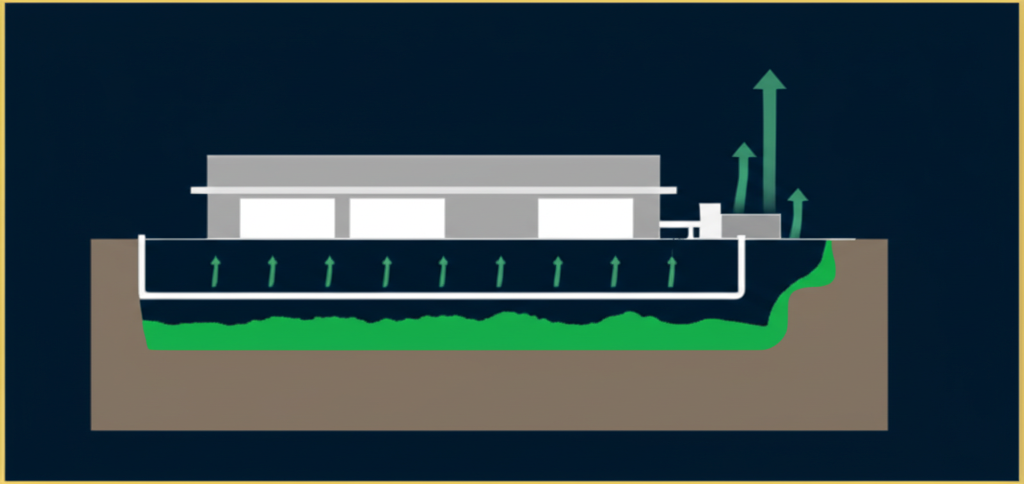
- Sub-Slab Depressurization (SSD): A system of suction pipes and an exhaust fan is installed to create a pressure differential below the slab that prevents soil gas from being drawn upward into the building. SSD is the most widely applied vapor intrusion mitigation technique and has demonstrated effectiveness at numerous sites. A properly designed SSD system can reduce indoor air concentrations by one to two orders of magnitude.
- Building pressurization: HVAC modifications to maintain the building at positive pressure relative to the subsurface, counteracting the pressure differential that drives vapor intrusion. Less common as a standalone approach but used in combination with SSD at complex sites.
- Ventilation enhancement: Increasing the building’s air exchange rate dilutes indoor air contaminant concentrations. Less reliable than SSD as a primary mitigation approach because it depends on HVAC operation and doesn’t address the source.
- Source remediation: Addressing the underlying subsurface contamination that drives vapor intrusion. For active vapor intrusion conditions, source remediation alone is rarely sufficient to achieve rapid indoor air quality improvement — the time required for subsurface cleanup typically makes mitigation of the immediate indoor air concern necessary regardless of the remediation timeline.
Vapor Intrusion in DFW Commercial Transactions
The Due Diligence Implication
For DFW commercial properties in areas with historical industrial land use, vapor intrusion is a due diligence issue that should be evaluated as part of Phase I and Phase II scope, not treated as an afterthought. The Phase I should identify the proximity of volatile contaminant sources — not just the regulatory status of those sources — and should evaluate whether the vapor intrusion pathway is a credible concern for the subject property given its location, geology, and building characteristics.
When Phase I findings indicate a credible vapor intrusion pathway, Phase II investigation scope should include soil vapor sampling as a primary deliverable — not an optional add-on. The cost of adding vapor probes and TO-15 analysis to a Phase II investigation is modest compared to the cost of a mitigation system, a regulatory compliance problem, or a worker health concern that emerges post-acquisition.
TCEQ Vapor Intrusion Guidance
TCEQ evaluates the vapor intrusion pathway as part of its TRRP risk assessment framework. The agency has published vapor intrusion guidance that specifies screening levels for sub-slab and indoor air concentrations of VOCs. For LPST cases, TCEQ’s case closure process increasingly requires vapor intrusion evaluation before a No Further Action determination is issued — which means that properties with open or recently closed LPST cases may have vapor intrusion investigation data available in the TCEQ regulatory file that should be reviewed as part of Phase I due diligence.
Bottom Line: Don’t Buy the Problem Below the Slab
Vapor intrusion is a subsurface-to-indoor-air pathway that operates invisibly, affects building occupants without their knowledge, and creates regulatory and liability exposure that can be discovered long after a transaction closes. In DFW’s historically industrial commercial corridors, it’s not a theoretical risk — it’s a documented condition at a substantial number of properties.
The appropriate response is not to avoid DFW commercial real estate with industrial history. It’s to evaluate the vapor intrusion pathway competently as part of environmental due diligence — before the transaction closes, while options for price adjustment, seller remediation, or mitigation planning are still available.
Vapor Intrusion Assessment in DFW
Vertexium Environmental Solutions evaluates vapor intrusion pathways as part of Phase I ESA scope, Phase II ESA design, and standalone vapor intrusion assessments for DFW commercial properties. If you’re acquiring property in a historically industrial DFW corridor and the Phase I hasn’t addressed vapor intrusion, it may not be giving you the full picture.
Contact us at vertexiumenv.com/contact.html to discuss vapor intrusion risk at your property.
Need Environmental Due Diligence?
Vertexium Environmental Solutions delivers Phase I ESAs with 2-3 week turnaround, fixed-fee pricing, and PhD-level technical review on every report.
Book a Free Consultation
Dr. Mohamed Elansary
PhD in Environmental Engineering from Texas A&M University-Kingsville. Founder of Vertexium Environmental Solutions, delivering Phase I/II ESAs and environmental due diligence for commercial real estate across the DFW Metroplex.