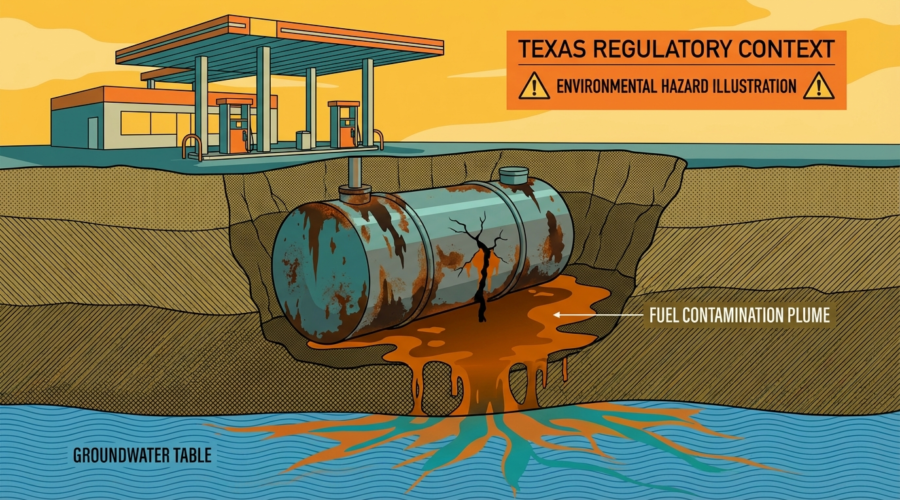
If you ask experienced environmental professionals what single source of contamination they encounter most frequently in Texas commercial real estate due diligence, the answer is almost always the same: underground storage tanks. Petroleum storage tank releases are the most documented, most widespread, and most frequently encountered source of commercial property contamination in the state — and the Dallas-Fort Worth Metroplex, with its dense commercial development and decades of vehicle-dependent growth, has one of the highest concentrations of current and former UST facilities in the country.
Understanding how UST contamination works, how it’s regulated in Texas, and how it affects commercial real estate transactions is fundamental to environmental due diligence in DFW. This post covers the full picture — from tank registration and closure to the TCEQ regulatory programs that govern petroleum releases, and what all of it means when you’re buying or selling commercial property.
How USTs Work — and Why They Fail
An underground storage tank is any tank (and associated piping) with 10% or more of its volume underground, used to store regulated substances — primarily petroleum products (gasoline, diesel, heating oil) but also certain hazardous chemicals. USTs range in size from small residential heating oil tanks (275 gallons) to large commercial and fleet tanks (50,000 gallons or more).
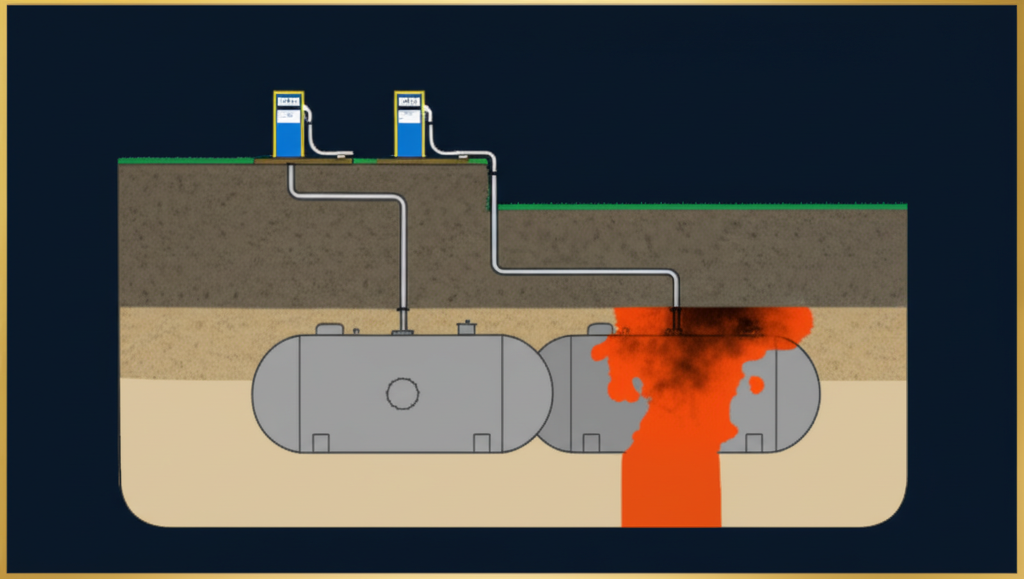
Before the late 1980s, most USTs were single-wall steel tanks installed directly in soil without corrosion protection, secondary containment, or leak detection systems. These tanks have a typical service life of 15-25 years before corrosion causes structural failures — pinhole leaks, seam failures, and connection leaks that release product into the surrounding soil.
The release mechanics are often subtle. A small pinhole leak in a 10,000-gallon tank might release one to five gallons per day — enough product in a year to contaminate thousands of cubic yards of soil and hundreds of feet of groundwater. These slow leaks typically go undetected for years, because in the absence of modern release detection systems, there’s no alarm, no visible surface evidence, and no odor above the concrete pad that covers the tanks.
When the contamination is eventually discovered — through a regulatory database check during property due diligence, a monitoring well installed for a nearby project, or a soil boring drilled for unrelated purposes — it may represent a decade or more of cumulative release. The plume of dissolved petroleum hydrocarbons (BTEX compounds — benzene, toluene, ethylbenzene, xylenes) in groundwater can extend hundreds of feet from the tank, migrating in the direction of groundwater flow regardless of property lines.
The TCEQ LPST Program: Texas’s Framework for Petroleum Releases
Texas regulates petroleum storage tank releases primarily through TCEQ’s Leaking Petroleum Storage Tank (LPST) program. The LPST program governs the reporting, investigation, and remediation of releases from petroleum storage tanks, and maintains a database of confirmed and suspected release sites across the state.
The Scale of the Problem in Texas
The TCEQ LPST database currently lists tens of thousands of confirmed and suspected release sites across Texas. In the DFW Metroplex alone, there are thousands of open and closed LPST cases — concentrated along commercial corridors where gas stations, fleet fueling facilities, and industrial petroleum storage have been present for decades.
This density of release sites has a direct implication for commercial due diligence: in established commercial areas of DFW, it is common for a subject property to have one or more LPST sites within the 1/8-mile search radius that ASTM E1527-21 specifies for UST facilities. The question is not usually whether there are LPST sites nearby — it’s whether those sites represent a current contamination risk to the subject property.
LPST Reporting Requirements
Texas requires the owner/operator of a regulated petroleum storage tank system to report a suspected release to TCEQ within 24 hours of discovery. Confirmed releases trigger a formal investigation and cleanup program under TCEQ’s regulatory oversight.
The timeline from release detection to regulatory closure can range from one to two years for minor releases with well-characterized contamination, to decades for complex sites with multiple contaminants, deep groundwater impacts, or difficult subsurface conditions. Many open LPST cases in the DFW database have been in active remediation for 15-20 years, reflecting the genuine difficulty of remediating petroleum contamination in the variable geology of the Metroplex.
What “Closed” Actually Means
When a TCEQ LPST case appears in the database as “closed,” many buyers interpret this as meaning the site is clean. That interpretation is often incorrect.
TCEQ closes LPST cases when:
- Contamination concentrations meet TCEQ’s applicable Protective Concentration Levels (PCLs) for the designated land use
- Institutional controls are in place that adequately manage residual contamination
- Natural attenuation is expected to achieve PCL compliance within a reasonable timeframe
A case closed under institutional controls may have residual contamination in soil or groundwater that exceeds PCLs for some land uses. A case closed to commercial PCLs may still have contamination above residential PCLs. A case closed through monitored natural attenuation may still have a dissolved-phase plume in groundwater.
For Phase I assessments, the closure documentation for any nearby LPST cases should be obtained and reviewed — not just the database status field. The closure conditions determine whether the site represents a continuing environmental concern for an adjacent property.
UST Registration: What’s Required and Where It Fails
TCEQ requires the owner of an underground storage tank to register the tank with the state. Registration creates a record of the tank’s existence, contents, and ownership — and registration records are one of the primary data sources for Phase I UST research.
But UST registration has significant gaps that create real risks in commercial due diligence:
Pre-Registration Era Tanks
Federal UST regulations (implementing the Energy Policy Act of 1992 and the Underground Storage Tank Compliance Act of 2005) and Texas state registration requirements have evolved over time. Tanks installed before registration requirements existed — and in some cases, tanks installed during the period when registration was required but enforcement was incomplete — may have no registration record whatsoever.
Historical aerial photographs and city directory research are often the only way to identify these unregistered tanks. A property that operated as a gas station from 1952 to 1968 may have no TCEQ registration record, but a 1960 aerial photograph showing fuel dispensers is strong evidence that USTs were present — and the absence of formal tank closure documentation is a recognized environmental condition regardless of the registration gap.
Deregistered ≠ Properly Closed
This is one of the most important distinctions in commercial real estate environmental due diligence: a tank that has been deregistered from TCEQ’s database is not necessarily a tank that has been properly closed and removed.
Proper tank closure under TCEQ regulations requires:
- Notification to TCEQ 30 days before closure
- Removal of all product from the tank
- Tank removal (preferred) or tank abandonment in place with proper filling (acceptable under specific conditions)
- Soil sampling in the excavation area (at the base and walls of the tank pit) to determine if a release occurred
- Documentation of the closure process and sampling results
Many tanks that were deregistered in the 1980s and 1990s were not closed in accordance with these requirements — they were simply taken out of service, sometimes pulled from the ground and hauled away without soil sampling, sometimes abandoned in place without documentation. The absence of formal tank closure documentation means that the soil and groundwater conditions in the former tank area are unknown.
For commercial properties where historical aerial photographs or city directory research indicates former gas station or fuel storage operations — regardless of whether the tanks appear in the current registry — the Phase I should identify the lack of closure documentation as a Recognized Environmental Condition (REC) or at minimum a Historical REC (HREC). In many cases, Phase II investigation is warranted to confirm actual conditions.
Release Detection and Compliance Gaps
For currently active UST facilities — gas stations, commercial fleet fueling, and industrial petroleum storage that may exist on or adjacent to your subject property — TCEQ requires leak detection systems that are capable of identifying releases before they become large. Required leak detection methods include:
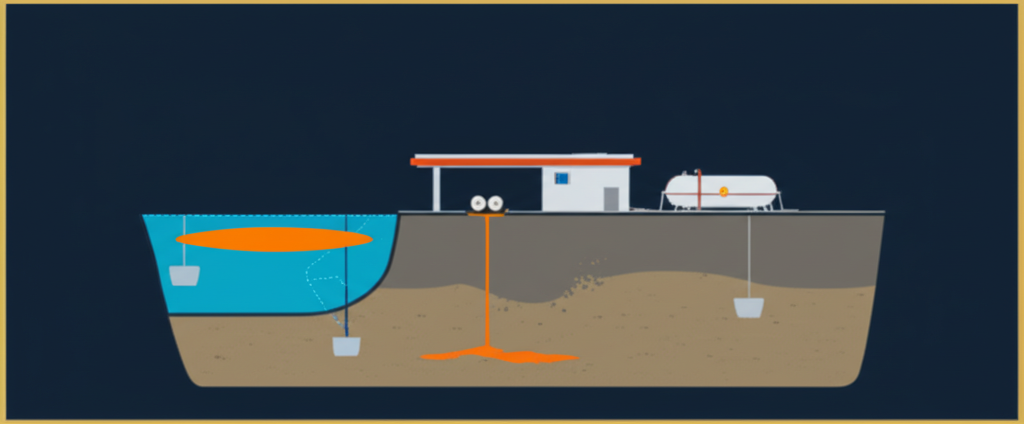
- Statistical inventory reconciliation (SIR) — automated comparison of fuel deliveries and sales to identify unexplained inventory losses
- Automatic tank gauging (ATG) systems with continuous monitoring
- Interstitial monitoring for double-wall tanks
- Vapor monitoring in the vadose zone adjacent to the tank
Compliance with release detection requirements is checked by TCEQ inspectors, but inspection frequency varies. In the DFW Metroplex, some UST facilities go years between formal inspections — and compliance gaps in release detection systems are not uncommon. During Phase I investigation, the current compliance status of active UST facilities on the subject property (or on adjacent properties that represent potential off-site sources) should be verified through TCEQ’s compliance database.
The TCEQ Petroleum Storage Tank (PST) Reimbursement Program
One aspect of Texas’s UST regulatory framework that significantly affects transaction analysis is the TCEQ Petroleum Storage Tank Cleanup Reimbursement Program. This program provides state funding to eligible owners and operators for cleanup costs associated with petroleum releases from USTs — up to $1 million per occurrence, with an annual cap.
Eligibility for the reimbursement program is not guaranteed. To qualify, the owner/operator must:
- Have been in compliance with UST registration and financial responsibility requirements at the time of the release
- Conduct the cleanup in accordance with TCEQ-approved procedures
- Submit and receive approval for a corrective action plan
- Document all cleanup expenditures
For buyers considering acquisition of properties with UST-related LPST cases, the reimbursement program can significantly affect the net cost of remediation — and understanding whether the current responsible party is eligible for reimbursement (and how much has already been reimbursed) is an important component of brownfield transaction analysis.
UST Due Diligence: What Phase I Should Accomplish
For commercial properties in the DFW Metroplex, UST-related due diligence during Phase I should accomplish the following:
Registry and Database Research
- TCEQ UST Registry search for tanks currently or formerly registered at the subject property and adjacent properties within 1/8 mile
- TCEQ LPST database search for confirmed or suspected release sites at the property and within 1/8 mile
- EPA Underground Storage Tank database search
- Review of TCEQ LPST case files for nearby release sites to determine case status, closure conditions, and current remediation progress
Historical Records Research
- Historical aerial photograph review for evidence of dispensing equipment, canopy structures, or vent pipes indicating former UST facilities
- City directory research for gas station, fleet fueling, or petroleum storage operations at the property
- Sanborn map research for properties in older commercial corridors
Site Reconnaissance
- Visual inspection for fill ports, vent pipes, dispensing equipment, or other evidence of current or former USTs
- Evaluation of pavement for irregularities that may indicate tank removal or subsidence over buried tanks
- Documentation of any monitoring wells, remediation equipment, or active treatment systems
When Phase II Is Warranted for UST Properties
Phase II investigation is typically warranted for properties where:
- Historical USTs are documented without formal closure records
- An open LPST case exists at or adjacent to the property, and the plume extent has not been fully characterized
- A closed LPST case involves residual contamination managed through institutional controls that may affect the proposed use
- Visual or analytical evidence of petroleum impacts is observed during Phase I site reconnaissance
For UST-related Phase II investigations, the scope typically includes shallow soil borings at and around former tank locations, groundwater monitoring wells to characterize the dissolved-phase plume, and laboratory analysis for BTEX compounds and TPH (total petroleum hydrocarbons). In some cases, geophysical surveys (ground-penetrating radar or electromagnetic surveys) are used to locate unregistered tanks that may have been abandoned in place.
Don’t Assume the Tank Problem Has Been Handled
Underground storage tanks are everywhere in the DFW commercial real estate market. The density of former gas stations, fleet fueling facilities, and industrial petroleum storage across the Metroplex means that almost any commercial property in an established area has some historical UST exposure — either on-site or from an adjacent source. Assuming the problem has been handled because a LPST case is closed, or because no active tanks appear in the current registry, is one of the most common due diligence failures I encounter.
At Vertexium Environmental Solutions, our Phase I ESAs treat UST due diligence as a core competency — comprehensive registry and database research, thorough historical records review, and site reconnaissance conducted by an Environmental Professional who knows what to look for. When Phase II investigation is warranted, we scope it specifically and interpret results in the context of TCEQ’s regulatory programs and the transaction’s specific risk profile.
Phase I and Phase II for UST characterization are scoped to the property and investigation requirements. Contact us at vertexiumenv.com/contact.html to discuss your property’s petroleum storage history before you close.
Need Environmental Due Diligence?
Vertexium Environmental Solutions delivers Phase I ESAs with 2-3 week turnaround, fixed-fee pricing, and PhD-level technical review on every report.
Book a Free Consultation
Dr. Mohamed Elansary
PhD in Environmental Engineering from Texas A&M University-Kingsville. Founder of Vertexium Environmental Solutions, delivering Phase I/II ESAs and environmental due diligence for commercial real estate across the DFW Metroplex.