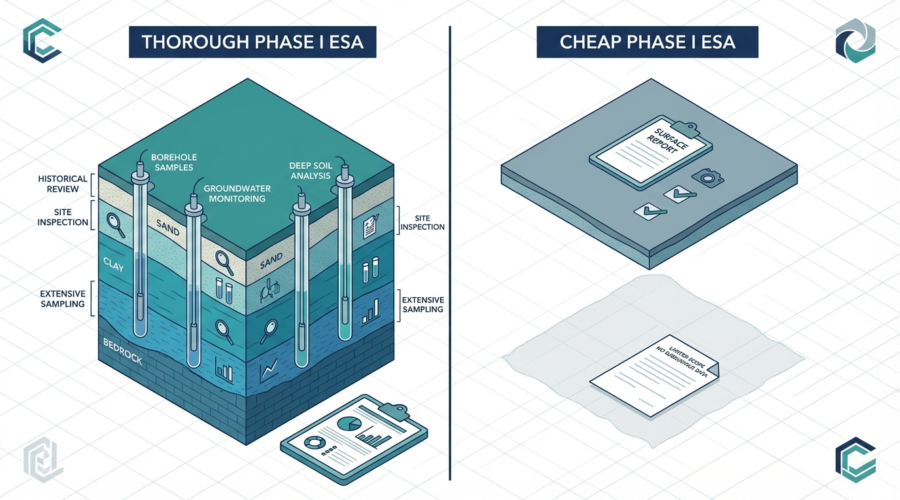
The quote comes in well below market. Sometimes half market rate. Occasionally a fraction of what a thorough assessment costs. And somewhere in Dallas or Fort Worth or one of the dozens of fast-growing suburban markets between them, a buyer signs off on it — because the price looks like savings, and because nobody has explained what they’re actually paying for.
I’ve reviewed Phase I Environmental Site Assessments prepared by competitors in this market. Some of those reports were priced as bargains. Most of them had things in common: generic historical review that didn’t go back far enough, database searches without analysis, site visits that checked boxes without evaluating actual risk conditions, and EP certifications signed by environmental professionals who hadn’t set foot in Texas, let alone walked the subject property.
The low-cost Phase I isn’t a deal. It’s a document. There’s a difference — and that difference has a dollar value that becomes apparent only when the contamination shows up that the cheap report missed.
What ASTM E1527-21 Actually Requires
The ASTM E1527-21 standard is the governing document for Phase I ESA practice in the United States. It defines what constitutes All Appropriate Inquiries (AAI) under CERCLA, establishes the scope of required investigations, and specifies the qualifications of the Environmental Professional who must sign the report.
Understanding the standard is the first step to understanding why price variation in Phase I ESAs isn’t like price variation in commodity services. Two Phase I reports both labeled “ASTM E1527-21 compliant” can be vastly different in actual quality, analytical depth, and protective value — because the standard defines minimum requirements, not a ceiling.
The Four Components of a Phase I ESA
ASTM E1527-21 requires four categories of inquiry:
- Records Review: Federal and state regulatory database searches, historical records review (aerial photographs, Sanborn maps, city directories, topographic maps), physical setting sources (geological and hydrogeological data), and regulatory agency file reviews where warranted.
- Site Reconnaissance: A physical inspection of the subject property and observation of adjacent properties to identify conditions that may indicate RECs, CRECs, or HRECs.
- Interviews: Interviews with current and past property owners, operators, and occupants; interviews with local government officials where records are not available through standard database sources.
- EP Report: A written report by a qualified Environmental Professional that documents the findings of the above three components and provides an opinion regarding RECs identified at the property.
Every one of these components has a quality floor and a quality ceiling. Bargain Phase I providers consistently operate at or near the floor on each.
Where Cheap Phase I Providers Cut Corners
Historical Research: The Most Dangerous Shortcut
Regulatory database searches are automated. You pay a third-party database vendor (EDR, Radius Map, etc.) for a standardized report that pulls federal and state environmental records within defined search radii. That part of the Phase I is relatively straightforward to execute and doesn’t vary much based on provider quality.
What varies dramatically is the historical research — the non-automated, professional-judgment-intensive work of reconstructing a property’s operational history from historical records. This is where low-cost providers consistently underperform, because thorough historical research is time-intensive and cannot be automated or outsourced to a data vendor.
In Dallas-Fort Worth specifically, thorough historical research requires:
- Sanborn Fire Insurance Map review dating to first developed use. The Metroplex has Sanborn coverage in many areas dating to the late 1800s and early 1900s. A cheap Phase I that starts its historical review in 1960 because “that’s when aerial photographs are available” has already missed 60-plus years of potential industrial, commercial, and manufacturing history.
- Sequential aerial photograph review at meaningful intervals. Aerial photography reviewed only at decade intervals can miss an industrial operation that existed for five years in the 1950s — long enough to contaminate a site with chlorinated solvents or petroleum products, not long enough to appear in coarse-interval review.
- City directory research for occupant identification. A commercial property in an older Dallas or Fort Worth neighborhood may have had dozens of occupants over 70 years. City directories, cross-referenced by property address, are the primary tool for identifying former industrial tenants not captured by Sanborn maps or aerial photographs.
A genuinely thorough historical review takes hours per property. A bargain Phase I allocates minutes. The contamination from a 1965 electroplating operation or a 1972 solvent degreasing facility doesn’t care how much you paid for your Phase I report.
Site Visit Quality: Walking vs. Looking
The site reconnaissance requirement under ASTM E1527-21 mandates a physical inspection by (or under the supervision of) the Environmental Professional. What that requirement doesn’t specify is how thorough the inspection must be, how long it must take, or what level of geological and regulatory knowledge the EP must apply to interpret what they observe.
Low-cost Phase I providers frequently fulfill the site visit requirement with a drive-by or a brief walkthrough that generates photographs of the property’s current condition without substantive evaluation of what those conditions mean in the context of the property’s history and the local regulatory and geological environment.
In DFW, a competent site reconnaissance identifies conditions that require local knowledge to properly evaluate:
- The presence of former railroad corridors — active, abandoned, or converted to trails or greenways — and their implications for arsenic herbicide application history in shallow soils
- The geological formation underlying the site (Eagle Ford clay, Austin Chalk, Woodbine Sand, Trinity Aquifer system) and the implications for contaminant fate and transport
- Evidence of former USTs in older commercial properties: fill ports mortared over and painted, vent pipes removed but penetration points visible in concrete, depressions or soft spots in paved areas consistent with abandoned tank excavation backfill settlement
- Drainage patterns and hydraulic gradients relevant to off-site contaminant migration pathways
None of this is visible to an EP who doesn’t understand DFW’s specific land use history, regulatory environment, and geological conditions. A cheap Phase I prepared by a national firm that processes hundreds of reports per week across dozens of states cannot apply this level of local knowledge.
EP Qualifications: Who Is Actually Signing the Report?
ASTM E1527-21 defines the qualifications required of the Environmental Professional who must review and sign the Phase I report. The EP must meet specific education and experience criteria — but “meeting criteria” on paper and having genuine expertise in the local regulatory and geological environment are different things.
The low-cost Phase I market frequently involves:
- National or regional firms where the signing EP has never visited the subject state, let alone the subject market
- Report preparation delegated entirely to junior staff or field technicians, with a senior EP’s signature affixed without substantive technical review
- Environmental Professionals who have the minimum required credentials but lack the depth of technical experience to exercise meaningful professional judgment about site conditions
In Texas, the Phase I also has a relationship with the Texas Risk Reduction Program (TRRP) framework — and a Phase I prepared by someone unfamiliar with TCEQ regulatory processes, TRRP PCLs, and the state’s LPST program will miss regulatory nuances that affect how RECs should be characterized.
The Math on Cheap Phase I Risk
The Contamination Discovery Scenario
Consider a scenario that plays out regularly in DFW commercial real estate: A buyer acquires a 2-acre industrial property in south Dallas for $1.8M. The Phase I ESA was prepared by a low-cost provider and came back clean — no RECs identified. Two years after closing, during site preparation for new construction, soil sampling required by the general contractor’s project specifications reveals petroleum hydrocarbon contamination in the area of the former loading dock.
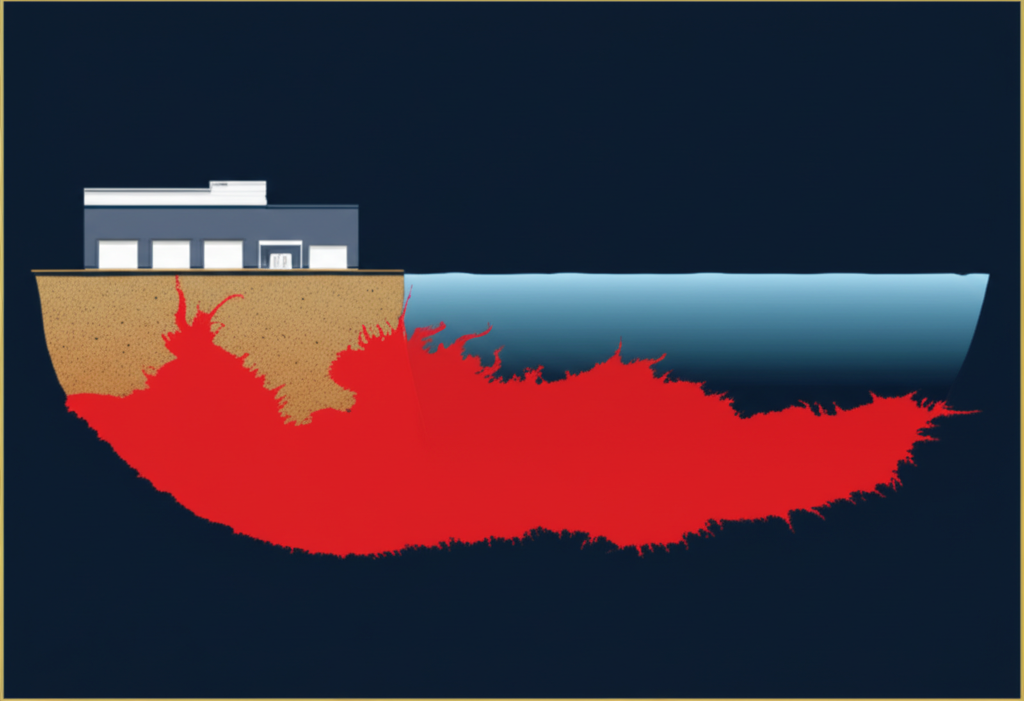
Investigation reveals an abandoned diesel UST installed in the 1960s that wasn’t identified in the Phase I’s historical review because the historical records search didn’t include city directory research or a thorough Sanborn map review for the property’s 1960s occupancy. The UST released petroleum product for decades before being abandoned in place. Cleanup costs come in at $285,000 — plus $40,000 in investigation costs, $60,000 in construction delays, and an indefinite hold on the development project while TCEQ’s LPST program processes the voluntary cleanup notification.
The cheap Phase I was priced well below market. A compliant, thorough Phase I would have identified this risk. The difference in assessment cost was small — and it cost $385,000 plus development delays to discover it.
The CERCLA Innocent Landowner Defense
This is the legal dimension of Phase I quality that too few buyers understand until it’s too late. CERCLA’s innocent landowner defense protects buyers who acquire contaminated property without knowledge of that contamination — but only if the pre-acquisition environmental assessment constituted All Appropriate Inquiries as defined in 40 CFR Part 312.
A Phase I ESA that fails to meet AAI requirements — because the historical records review was inadequate, because the site visit was insufficient, because the EP didn’t meet qualification requirements — doesn’t establish the innocent landowner defense. If contamination is later discovered, the buyer can be held liable under CERCLA as a potentially responsible party even though they had no involvement in creating the contamination.
The cheap Phase I didn’t just fail to find contamination. It may have failed to establish the legal protection that makes discovery of contamination survivable from a liability standpoint.
What a Quality Phase I ESA Includes
A properly scoped Phase I ESA for a standard DFW commercial property includes:
- Comprehensive regulatory database research covering all ASTM-required federal and state databases
- Historical records review dating to first developed use — Sanborn maps, sequential aerial photographs at 5-10 year intervals, city directory research, topographic maps, building permits where relevant
- In-person site reconnaissance by a qualified Environmental Professional with Texas-specific regulatory and geological knowledge
- Adjacent property and off-site source evaluation including groundwater flow direction analysis
- Regulatory agency file review for properties with open TCEQ cases within search radius
- EP report with substantive REC analysis, not just database listing
- Texas PE-licensed Environmental Professional signature where required for TCEQ submissions
This is the standard that establishes your AAI documentation, protects your CERCLA innocent landowner defense, and gives you environmental risk intelligence that’s actually useful for transaction decision-making.
The Decision Is Straightforward
On a commercial real estate transaction of any meaningful size, the additional cost of a quality Phase I ESA over a bargain alternative is a rounding error. The risk exposure from a deficient Phase I — contamination missed, innocent landowner defense not established, transaction liability not understood — is not.
Environmental due diligence isn’t an expense category to optimize. It’s a risk management function. And like all risk management, the value isn’t visible when everything goes right. It’s only visible when something goes wrong — and by then, the cost of the cheap option becomes very clear.
Ready for a Phase I You Can Trust?
Vertexium Environmental Solutions conducts Phase I ESAs throughout the Dallas-Fort Worth Metroplex. Every assessment is prepared by a Texas PE-licensed environmental professional with a PhD in environmental engineering and deep knowledge of DFW’s geology, land use history, and TCEQ regulatory framework.
Contact us at vertexiumenv.com/contact.html.
Need Environmental Due Diligence?
Vertexium Environmental Solutions delivers Phase I ESAs with 2-3 week turnaround, fixed-fee pricing, and PhD-level technical review on every report.
Book a Free Consultation
Dr. Mohamed Elansary
PhD in Environmental Engineering from Texas A&M University-Kingsville. Founder of Vertexium Environmental Solutions, delivering Phase I/II ESAs and environmental due diligence for commercial real estate across the DFW Metroplex.