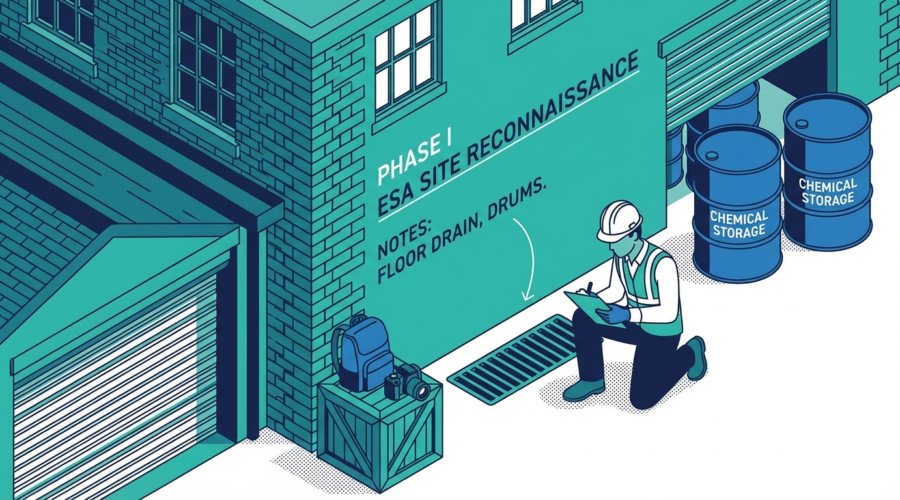
Most people who have ordered a Phase I Environmental Site Assessment know that it involves “someone going to look at the property.” What they don’t know — and what matters enormously for the quality of the assessment — is what that person is actually looking at, why each component matters, and how the findings from the site visit connect to the legal and financial conclusions of the report.
The site reconnaissance is one of the four required components of an ASTM E1527-21 Phase I ESA (alongside historical records review, regulatory database review, and interviews). It is the only component that puts eyes on actual physical conditions at the property. Done thoroughly, it confirms or contradicts the historical record and identifies conditions that no database search could find. Done superficially, it creates a false sense of security about conditions that exist below the surface.
As an ASTM E1527-21 Environmental Professional who has conducted site reconnaissance on hundreds of commercial properties across the Dallas-Fort Worth Metroplex, I want to walk through exactly what a thorough site visit involves — and why it takes more than two hours and a camera.
The Purpose of Site Reconnaissance
The ASTM standard defines the purpose of site reconnaissance as identifying conditions indicative of recognized environmental conditions (RECs), controlled recognized environmental conditions (CRECs), and historical recognized environmental conditions (HRECs). In plain language: the Environmental Professional is looking for physical evidence of current or historical contamination, hazardous materials, or conditions that suggest contamination may exist.
Critically, the site visit is not a sampling event. No soil borings are drilled. No groundwater samples are collected. No laboratory analysis is conducted. The site reconnaissance is an observational assessment — which means its value depends entirely on the knowledge, experience, and methodological rigor of the Environmental Professional conducting it.
An EP who knows that perchloroethylene (PCE) releases typically occur through floor drains in dry cleaning operations will look at floor drains differently than an EP who doesn’t understand how solvents are released to the subsurface. An EP who knows that chlorinated solvent contamination can cause stressed or dead vegetation will notice the anomalous brown patch in the lawn. An EP who understands the behavior of dense non-aqueous phase liquids (DNAPLs) in DFW’s clay-dominated geology will interpret staining patterns differently than one who doesn’t.
The site reconnaissance is where technical knowledge becomes practical assessment.
Interior Evaluation: What I’m Looking for Inside the Building
The interior evaluation is often the most time-intensive component of the site visit for commercial properties. For a multi-tenant commercial building, each accessible tenant space should be evaluated — not just the common areas. Here’s what I’m evaluating in detail:
Floor Drains and Utility Penetrations
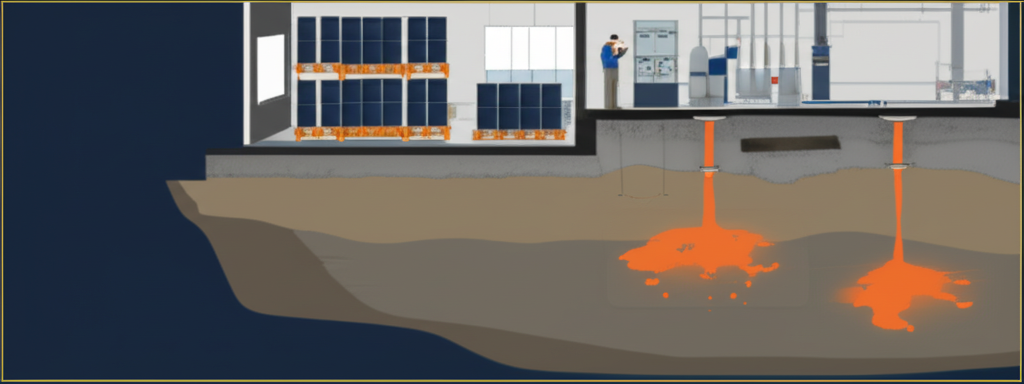
Floor drains are one of the most important features to evaluate in any commercial building. Drains installed prior to modern plumbing codes frequently discharged directly to the subsurface — meaning that anything poured down those drains over the years went directly into the soil beneath the building. I’m looking for:
- The presence, location, and condition of all floor drains
- Evidence of discharge piping — whether drains connect to the sanitary sewer system, a septic system, or a direct discharge to the subsurface
- Staining in and around drain areas, which may indicate the types of materials historically discharged
- Sumps, pit drains, or trenched drains in vehicle service or industrial areas
Utility penetrations through floor slabs also represent pathways for both historical releases and ongoing vapor intrusion — I document the size, seal condition, and location of penetrations relative to known or suspected subsurface conditions.
Chemical Storage and Hazardous Materials
Current chemical storage is evaluated both for its own regulatory status and as an indicator of the types of chemicals that have historically been used at the property. I’m looking at:
- All chemical storage areas — cabinets, closets, mechanical rooms, outdoor storage areas
- The types and quantities of chemicals present, noting specific compounds of regulatory concern (solvents, petroleum products, pesticides, corrosives, oxidizers)
- Container condition — integrity, labeling, secondary containment, evidence of leaks or spills
- Storage practices relative to regulatory requirements (proper labeling, appropriate containers, secondary containment where required)
- Waste storage — satellite accumulation areas, 90-day storage areas, evidence of unlabeled or abandoned waste containers
Staining and Residue
Floor staining is one of the most informative observations in a commercial building site visit. Different staining patterns suggest different types of releases:
- Dark, petroleum-like staining around drain areas in automotive or industrial spaces suggests historical petroleum product releases
- White crystalline deposits on concrete surfaces may indicate chemical residue from historical spills
- Discoloration patterns on walls adjacent to chemical storage areas can indicate past container failures
- Bleached or stained areas on concrete flooring may suggest solvent releases or chemical cleaning operations
Staining that appears old or has been painted over is often more significant than recent staining — it suggests historical conditions that may have already migrated to the subsurface.
Underground Storage Tanks (USTs) and Above-Ground Storage Tanks (ASTs)
Evidence of current or former USTs can include:
- Fill ports in floors or paved areas (often covered with plates)
- Vent pipes extending through floors or walls
- Pumping equipment or dispensing infrastructure
- Unnaturally thick floor slabs that may have been poured over a removed tank
- Monitoring well heads in the floor (indicating an active or former remediation system)
Above-ground storage tanks are evaluated for their size, contents, integrity, secondary containment adequacy, and any evidence of releases or overfill events.
Asbestos-Containing Materials (ACM) and Lead-Based Paint
While Phase I ESAs are not required to sample materials for asbestos or lead — those are the province of a separate asbestos survey or lead assessment — the EP should note the presence of suspect ACM and lead-based paint if observed and document their condition and likely exposure status.
In DFW’s commercial building stock, the highest-risk categories include buildings constructed before 1980 with:
- Vinyl floor tiles and associated mastic adhesives (friable ACM risk)
- Pipe insulation, boiler insulation, duct insulation
- Acoustic ceiling tiles and spray-applied fireproofing
- Exterior paint on pre-1978 structures
PCBs and Electrical Equipment
Polychlorinated biphenyls (PCBs) were used as dielectric fluid in electrical transformers and capacitors through the late 1970s. Older electrical equipment — particularly large oil-filled transformers — should be evaluated for PCB content. Leaking transformer oil can create significant soil contamination, particularly in areas with in-ground transformer vaults.
Exterior Evaluation: What I’m Looking for Outside
The exterior evaluation covers the building’s perimeter, the surrounding land surface, and observable conditions on adjacent properties.
Fill Material and Topographic Anomalies
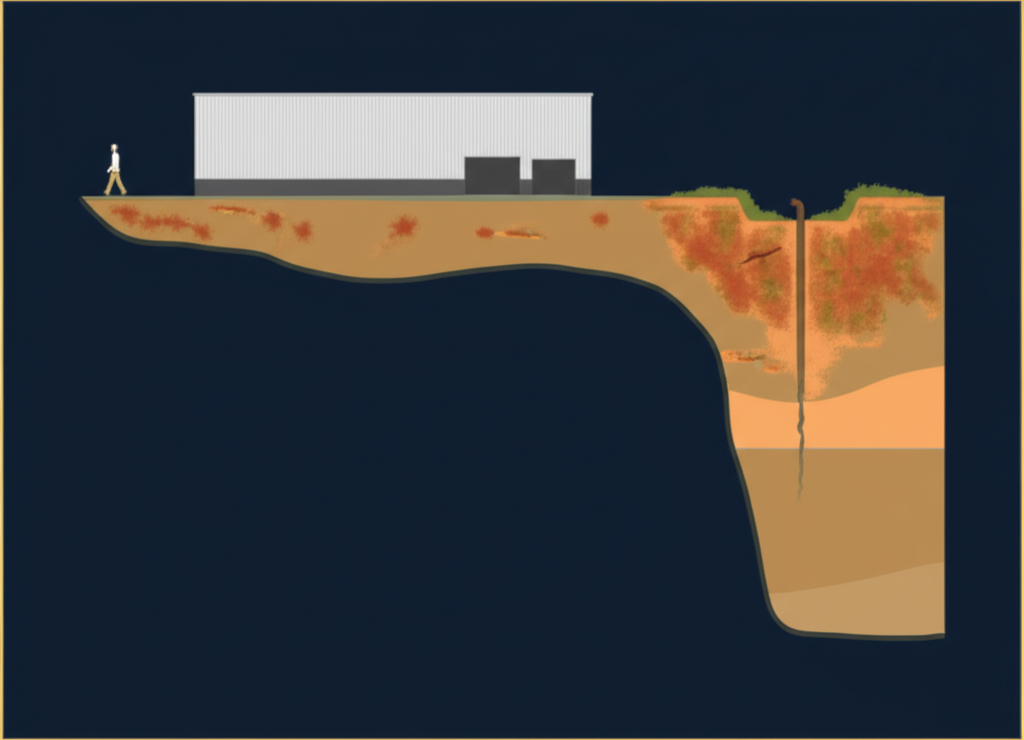
Uncharacterized fill material — soil, debris, or other materials brought onto the site to raise grade or level terrain — is a recognized environmental concern because fill material from industrial or contaminated sources can introduce contaminants to otherwise clean sites. I’m looking for:
- Irregular topography that may indicate the presence of fill material (unnatural depressions, mounds, or changes in grade)
- Visual evidence of disturbed soil or heterogeneous surface materials
- Locations where the natural soil profile appears to have been altered or replaced
In the DFW Metroplex, this is particularly relevant for properties that were developed in low-lying areas adjacent to industrial corridors, where fill material was sometimes sourced from industrial sites or demolition debris.
Stressed or Absent Vegetation
Subsurface contamination can affect surface vegetation in observable ways. Petroleum hydrocarbons in shallow soil reduce available oxygen to root zones, causing stressed or dead vegetation in patterns that often follow subsurface plume geometry. Chlorinated solvents at high concentrations can have similar effects. Stressed vegetation in an otherwise healthy landscape — particularly in a pattern that doesn’t correspond to drainage, shade, or soil type — warrants attention.
Surface Water, Drainage Patterns, and Seeps
I evaluate surface water features including drainage channels, detention ponds, and stormwater conveyance systems. Areas where contaminated groundwater may be expressing at the surface — seeps, unusual odors at drainage features, sheen on standing water — are documented. The direction of surface water drainage relative to potential contamination sources determines potential off-site migration pathways.
Adjacent Property Conditions
The adjacent properties within the ASTM-specified search radius are evaluated visually during the reconnaissance. Current uses that may represent off-site contamination sources — active or former gas stations, industrial facilities, dry cleaning operations, railroad corridors — are documented and evaluated in context with the regulatory database findings.
Interviews: The Human Record
Site reconnaissance under ASTM E1527-21 also encompasses structured interviews with key individuals who have knowledge of the property’s history and current conditions.
Owner/Operator Interview
The current property owner or operator is interviewed to obtain information about:
- Current and historical uses of the property and tenant spaces
- Any known or suspected contamination, spills, or environmental incidents
- Environmental permits or regulatory compliance history
- Previous environmental studies or reports conducted on the property
- Any environmental liens or regulatory notifications received
Site Manager or Key Employee Interview
If available, individuals with long-term operational knowledge of the property — building managers, longtime employees, maintenance staff — can provide information that doesn’t exist in any written record. A maintenance superintendent who has worked in a building for 25 years knows about the floor drain that was sealed in 1998, the transformer that leaked for years before it was replaced, and the tenant who used to store drums in the back corner. This kind of institutional knowledge is irreplaceable.
Government Official Records
ASTM E1527-21 requires the EP to make reasonable attempts to contact regulatory officials who may have information about the property or adjacent sites. In DFW, this typically means TCEQ regional office staff and local fire marshal records — both of which can provide information about regulatory actions that may not yet appear in online databases.
Synthesizing Reconnaissance Findings into Professional Judgment
The final — and most important — step of the site reconnaissance is synthesis. Each observation from the interior evaluation, exterior evaluation, and interviews is evaluated in the context of the historical records and regulatory database findings to reach a professional judgment about whether RECs exist at the property.
This synthesis is where the expertise of the Environmental Professional makes its greatest difference. An EP who doesn’t understand how PCE behaves in fractured limestone won’t connect a historical dry cleaning operation to a vapor intrusion concern. An EP who hasn’t reviewed historical aerial photographs won’t recognize that the current landscaped area used to be an unlined impoundment. An EP who doesn’t understand TCEQ’s regulatory database structure won’t identify a relevant adjacent site that appears under an older site name.
The site reconnaissance is observation. The conclusions are professional judgment. Both require an EP who understands what they’re looking at and what it means.
What This Means When You Commission a Phase I
When you’re evaluating Phase I ESA proposals, the scope of the site reconnaissance is a meaningful differentiator between firms. Relevant questions:
- Will the EP visit all accessible areas of the interior, including all tenant spaces?
- Will the EP evaluate adjacent properties during the exterior reconnaissance?
- Will formal interviews be conducted with the owner/operator and site personnel?
- Who specifically will be conducting the reconnaissance — a licensed EP, or a field technician?
- How will reconnaissance findings be integrated with historical records and database findings in the final report?
A Phase I report that reflects a thorough site reconnaissance is a fundamentally different product from one that reflects a two-hour walk-through. The difference may not be visible in the cover page or the executive summary — but it shows up in the findings, and it determines whether your environmental liability exposure is actually known or just assumed to be manageable.
Schedule a Phase I with an EP Who Knows What to Look For
At Vertexium Environmental Solutions, site reconnaissance is conducted by an ASTM E1527-21 Environmental Professional with doctoral-level environmental engineering expertise — not delegated to junior field staff. We evaluate every accessible area of the property, document conditions with comprehensive photography, and synthesize all findings with the historical record to deliver Phase I ESAs that actually identify conditions.
Phase I ESA pricing is scoped to the property. For properties with complex history or high-risk uses, we’ll scope appropriately and tell you why. Contact us at vertexiumenv.com/contact.html to discuss your property.
Need Environmental Due Diligence?
Vertexium Environmental Solutions delivers Phase I ESAs with 2-3 week turnaround, fixed-fee pricing, and PhD-level technical review on every report.
Book a Free Consultation
Dr. Mohamed Elansary
PhD in Environmental Engineering from Texas A&M University-Kingsville. Founder of Vertexium Environmental Solutions, delivering Phase I/II ESAs and environmental due diligence for commercial real estate across the DFW Metroplex.