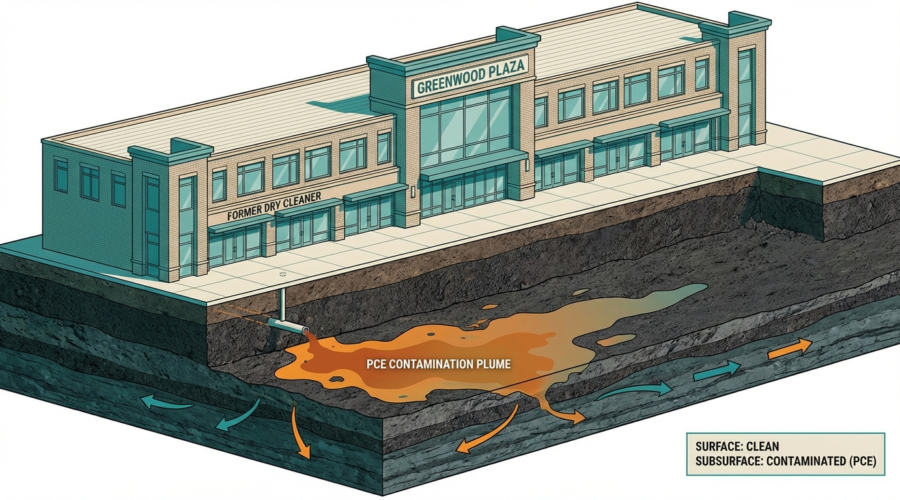
A buyer is weeks from closing on a strip mall in the southern DFW Metroplex. The property looks immaculate — fresh paint, clean parking lot, no visible staining, no odors. The tenants have been quietly operating for years. The seller’s disclosure says nothing unusual. And yet, buried three feet below the concrete slab that runs the length of that strip mall is a plume of perchloroethylene (PCE) that has been migrating through the subsurface for the better part of three decades.
The dry cleaner that occupied the end unit from 1981 to 2004 is long gone. The PCE it used to clean clothes is not.
As an ASTM E1527-21 Environmental Professional conducting Phase I Environmental Site Assessments across the DFW Metroplex, I’ve seen this scenario play out repeatedly. The property looks clean. The Phase I from 2018 — submitted by the lender’s environmental review department — says no recognized environmental conditions. The buyer closes. And then someone drills a monitoring well, or the regulatory database gets updated, and the truth emerges: the property has a contamination problem that predates the current owner’s tenure by two decades.
Under CERCLA, the current owner is now liable. The law doesn’t care that they didn’t put the PCE there.
Why Properties That Look Clean Are Often Anything But
The fundamental problem with environmental contamination is that it’s almost entirely invisible. You cannot see chlorinated solvents in groundwater. You cannot smell petroleum hydrocarbons dissolved in soil at concentrations that exceed regulatory action levels. You cannot detect heavy metals in shallow fill material by walking the site. The conditions that create significant environmental liability — and the legal exposure that comes with it — leave no fingerprints on the surface of the property.
Strip malls are a particularly instructive example because of their tenant history. A strip mall built in DFW in the 1970s or 1980s has typically housed a revolving door of tenants over five decades — and the types of businesses that occupied those spaces were often the highest-risk categories from an environmental perspective:
- Dry cleaners — The dominant solvent used in commercial dry cleaning for most of the 20th century was PCE (perchloroethylene, also called tetrachloroethylene or PERC). PCE is a dense non-aqueous phase liquid (DNAPL), meaning it sinks through the soil column and groundwater, migrating downward until it encounters an impermeable layer. PCE contamination from a single dry cleaning operation can create a subsurface plume that extends hundreds of feet from the source and persists for 50 years or more.
- Auto repair shops — Vehicle service operations generate multiple waste streams: used motor oil, hydraulic fluid, antifreeze, brake fluid, and chlorinated degreasers. Floor drains in automotive shops frequently discharged directly to the subsurface prior to modern plumbing codes. USTs for used oil storage were common and frequently unregistered.
- Photo processing labs — Commercial photography labs used silver compounds, hydroquinone, acetic acid, and a range of developer and fixer chemicals. Many of these compounds were disposed of through floor drains or sanitary sewer connections that discharged to the subsurface.
- Nail salons and beauty operations — Acetone, toluene, formaldehyde, and various organic solvents are used in personal care operations. These are often overlooked as low-risk tenants, but cumulative releases through small drains over years can create detectable soil impacts.
- Small manufacturing and printing operations — Strip malls in older commercial corridors frequently housed light manufacturing, screen printing, and electronics assembly — all of which involve organic solvents and metal compounds.
PCE: The Invisible Threat in Dallas-Fort Worth
PCE deserves special attention because of how commonly it appears in Phase II investigations across DFW, and how poorly its behavior is understood by buyers, brokers, and even some environmental professionals.
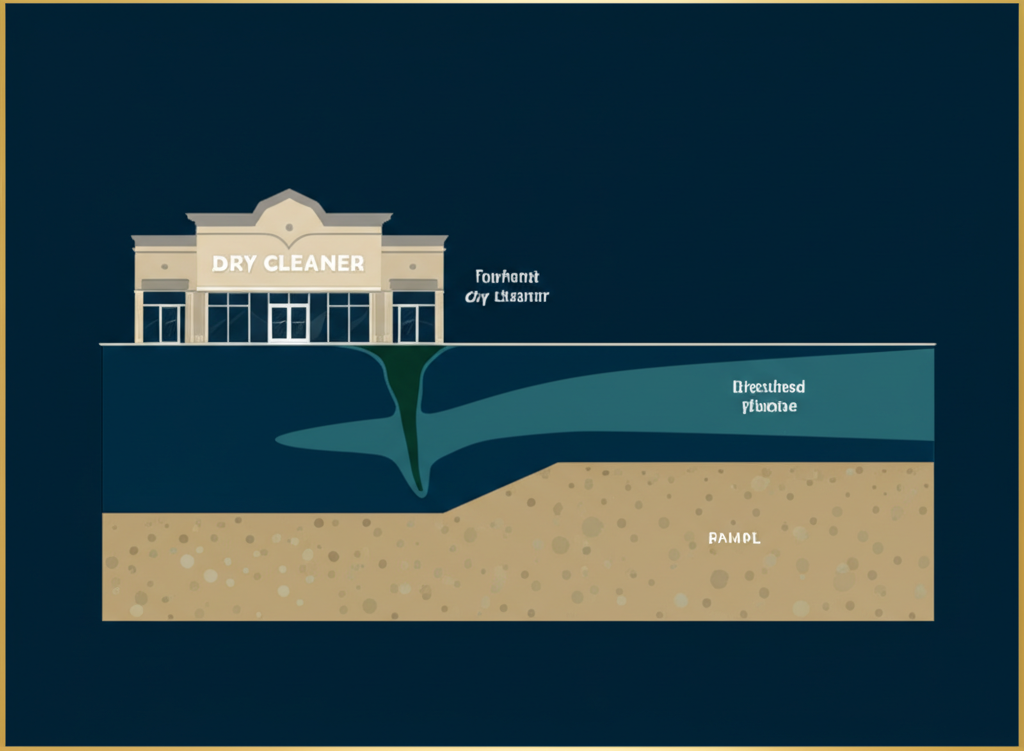
PCE is a chlorinated solvent — specifically, a dense non-aqueous phase liquid (DNAPL). Its physical properties make it one of the most challenging contaminants to remediate in the subsurface:
- It is denser than water, so it sinks through the saturated zone rather than floating on the water table.
- It has low aqueous solubility but is still soluble enough to create dissolved-phase plumes that migrate with groundwater flow.
- It biodegrades slowly under most subsurface conditions, producing breakdown products (TCE, cis-1,2-DCE, vinyl chloride) that are themselves regulated contaminants — and in some cases more toxic than the parent compound.
- In DFW’s geology — expansive clay formations, fractured limestone, variable depth to groundwater — PCE behavior is particularly unpredictable. Contaminant migration pathways are controlled by fractures, sand lenses, and preferential flow paths that are invisible to surface observation.
The drinking water maximum contaminant level (MCL) for PCE is 5 micrograms per liter (5 ppb). A dry cleaner that operated for 20 years and released PCE through its floor drain can generate dissolved-phase concentrations thousands of times higher than the MCL in the immediate subsurface — and that plume doesn’t stop migrating when the business closes.
Why the Phase I From 2018 May Not Protect You Today
Environmental due diligence has a shelf life. This is codified in regulation — ASTM E1527-21, the standard that governs Phase I Environmental Site Assessments, specifies that the report must be updated if it is more than 180 days old at the time of property acquisition. That 180-day currency requirement exists for good reason: the environmental risk profile of a property can change significantly in six months.
A Phase I report from five or ten years ago creates additional problems beyond currency:
The Standard Itself Has Changed
ASTM E1527-21 became effective on February 14, 2023, superseding the previous E1527-13 standard. The 2021 revision introduced several significant changes, including formal consideration of emerging contaminants, revised requirements for vapor migration evaluation, and updated regulatory database search requirements. A Phase I conducted under the 2013 standard may not have evaluated vapor intrusion pathways or considered per- and polyfluoroalkyl substances (PFAS) — issues that can create significant liability in properties that were considered clean under older standards.
Regulatory Databases Have Been Updated
TCEQ’s database of petroleum storage tank release sites (LPST), documented industrial hazardous waste sites (IHW), and voluntary cleanup program sites (VCP) is updated continuously. A Phase I from 2018 reflects the database snapshot from that year. Sites that were identified, entered into remediation programs, or discovered between 2018 and today would not appear in the older report — even if they represent significant off-site sources of contamination for the subject property.
New Tenants Create New Conditions
If the subject property has had tenant turnover since the last Phase I, new business operations may have introduced new contaminants to the site. A Phase I that was clean when the dry cleaning space was vacant may look very different if a new dry cleaner moved in — and the current Phase I needs to evaluate current tenant operations, not just historical ones.
CERCLA Liability: Why “I Didn’t Do It” Is Not a Defense
The Comprehensive Environmental Response, Compensation, and Liability Act (CERCLA) — commonly known as Superfund — was enacted in 1980 and establishes the framework for environmental cleanup liability in the United States. CERCLA’s liability provisions are deliberately broad and harsh:
- Strict liability — Liability attaches regardless of fault or negligence. If you own a contaminated property, you can be held liable for cleanup costs even if you had nothing to do with the contamination.
- Joint and several liability — Each responsible party can be held liable for the entire cost of cleanup, not just their proportionate share. This means a current owner can be required to fund 100% of a remediation even if they were responsible for 0% of the contamination.
- Retroactive liability — CERCLA reaches back to contamination that occurred before the law was enacted. Activities that were legal in 1965 can create CERCLA liability today.
The only meaningful defenses to CERCLA liability for property purchasers are the “innocent landowner” defense and the “bona fide prospective purchaser” defense — both of which require that the buyer conducted All Appropriate Inquiries (AAI) prior to acquisition. AAI is satisfied through a Phase I ESA conducted in accordance with ASTM E1527-21.
In other words: the Phase I ESA is not a checkbox for lenders. It is the legal foundation of your liability protection.
What a Proper Phase I Actually Evaluates for Strip Malls
When I conduct a Phase I ESA on a strip mall or multi-tenant commercial property in DFW, the historical tenant research is one of the most time-intensive components of the assessment. The goal is to reconstruct who occupied each tenant space, for how long, and what they did there — going back to the property’s first developed use.
This requires multiple information sources that are often overlooked in lower-quality assessments:
- Historical aerial photographs — Available from USGS, state archives, and commercial providers, aerial photos establish the physical development of the property over time and can reveal prior uses that are no longer apparent on the surface.
- Sanborn fire insurance maps — For older commercial corridors, Sanborn maps document building footprints, construction materials, and occupancy types back to the late 1800s.
- City directory records — Annual city directories list business occupants by address, providing a year-by-year record of tenant changes that can span decades.
- Building permit records — Local government permit databases record construction, renovation, and change-of-use permits that can reveal when specific uses were established or discontinued.
- Business license records — Many municipalities maintain historical business license databases that document the type of business operating at each address.
- TCEQ regulatory databases — LPST, IHW, VCP, and CERCLIS databases must be searched to identify any regulatory actions associated with the subject property or adjacent properties within the ASTM-specified search radii.
For a strip mall with a complex tenant history, this research process is not quick — and shortcuts in this phase of the assessment are where significant contamination goes undetected.
The Vapor Intrusion Problem
PCE and other chlorinated solvents create a contamination pathway that goes beyond groundwater: vapor intrusion. Volatile organic compounds (VOCs) in contaminated soil or groundwater can volatilize and migrate upward through the soil column, entering overlying structures through foundation cracks, utility penetrations, floor drains, and sumps.
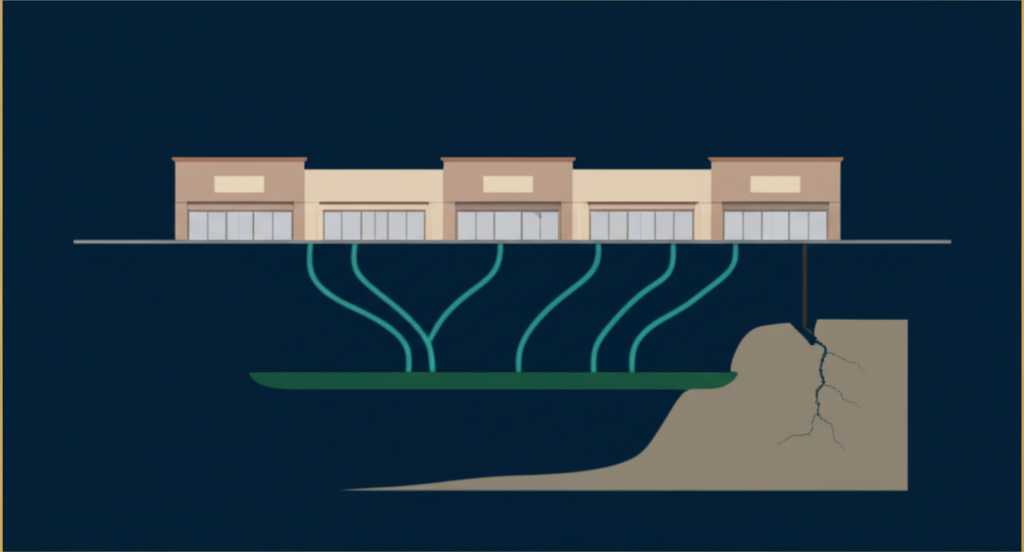
This matters for strip malls in two ways:
First, the building itself may be the receptor for vapor intrusion from subsurface contamination — either from on-site historical releases or from an off-site source upgradient of the property. Indoor air quality impacts from vapor intrusion can be significant at concentrations that don’t create visible symptoms, but that exceed EPA screening levels for chronic exposure.
Second, ASTM E1527-21 now explicitly requires evaluation of vapor migration as a pathway for recognized environmental conditions. A Phase I report that doesn’t address vapor intrusion is not compliant with the current standard.
What to Do When the Phase I Identifies Concerns
A Phase I that identifies recognized environmental conditions (RECs) related to prior dry cleaning operations, automotive repair, or other historical uses is not a deal-killer. It is an information document. The appropriate next step depends on the nature of the REC:
- If the REC is based on a current or historical regulatory database listing, the Phase I should determine the current status of the regulatory action — whether it has been closed, whether remediation is ongoing, and what institutional controls (if any) are in place.
- If the REC reflects a historical use without confirmed contamination, a Phase II Environmental Site Assessment may be warranted to collect soil and groundwater samples to characterize actual conditions.
- If the REC reflects confirmed contamination that is being addressed under TCEQ’s VCP or other regulatory programs, the transaction can potentially proceed with appropriate contractual protections — indemnification, escrow holdbacks, environmental insurance, or deed restrictions.
The worst outcome is not identifying a contamination problem. It’s buying a property without knowing the problem exists — and inheriting the full weight of CERCLA liability with no legal protections and no negotiating leverage.
Environmental Due Diligence Is Not Optional in DFW’s Current Market
The DFW commercial real estate market has experienced extraordinary growth over the past decade. Legacy commercial corridors along I-30, I-35, and I-20 are being redeveloped. Former industrial areas in south Dallas, West Dallas, and east Fort Worth are attracting investment. Strip malls in established suburban communities are being repositioned and re-tenanted.
Every one of these properties carries an environmental history that may not be visible from the parking lot. In a market moving this fast, the temptation to cut corners on due diligence is real — but the consequences of inadequate environmental assessment attach to the property and to the owner, not to the broker who pushed for a faster timeline or the lender who approved a shorter due diligence period.
Do your due diligence. Do it right. Do it to the current standard.
Ready to Protect Your Next Commercial Acquisition?
At Vertexium Environmental Solutions, we conduct Phase I Environmental Site Assessments that go beyond the minimum — comprehensive historical tenant research, thorough regulatory database review, and professional judgment from an Environmental Professional with doctoral-level environmental engineering expertise from Texas A&M University-Kingsville.
Phase I ESA pricing is scoped to the property. If a Phase II investigation is warranted, we provide a clear, defensible scope of work that quantifies the actual conditions — not worst-case speculation.
Don’t let “it looks clean” be the most expensive assumption you make this year. Contact us at vertexiumenv.com/contact.html to discuss your property before you close.
Need Environmental Due Diligence?
Vertexium Environmental Solutions delivers Phase I ESAs with 2-3 week turnaround, fixed-fee pricing, and PhD-level technical review on every report.
Book a Free Consultation
Dr. Mohamed Elansary
PhD in Environmental Engineering from Texas A&M University-Kingsville. Founder of Vertexium Environmental Solutions, delivering Phase I/II ESAs and environmental due diligence for commercial real estate across the DFW Metroplex.