Environmental liability in commercial real estate transactions is frequently misunderstood — by buyers, brokers, attorneys, and sometimes even the environmental consultants who are supposed to be managing it. The phrase “CERCLA liability” gets thrown around in due diligence discussions as a generic warning, but few people in the transaction understand what it actually means in legal and practical terms.
This post breaks down how CERCLA liability actually works for Texas commercial property buyers, what the defenses are, how Texas-specific programs interact with federal law, and why the Phase I ESA is not optional if you want those defenses to hold.
I meet the ASTM E1527-21 Environmental Professional qualifications with a PhD in Environmental Engineering from Texas A&M University-Kingsville, and I’ve conducted Phase I and Phase II Environmental Site Assessments across the DFW Metroplex. Understanding CERCLA isn’t academic for the work we do — it’s the legal framework that gives the Phase I ESA its practical importance.
What CERCLA Actually Does
The Comprehensive Environmental Response, Compensation, and Liability Act (CERCLA), enacted in 1980, does two things: it funds the cleanup of contaminated sites (primarily through the Superfund trust fund), and it establishes who is legally responsible for paying for those cleanups.
CERCLA identifies four categories of “potentially responsible parties” (PRPs) who can be held liable for response costs at a contaminated site:
- Current owners and operators of a facility where hazardous substances have been released
- Past owners and operators who owned or operated the facility at the time of disposal
- Arrangers for disposal — entities that arranged for the disposal or treatment of hazardous substances at the facility
- Transporters who selected the disposal facility
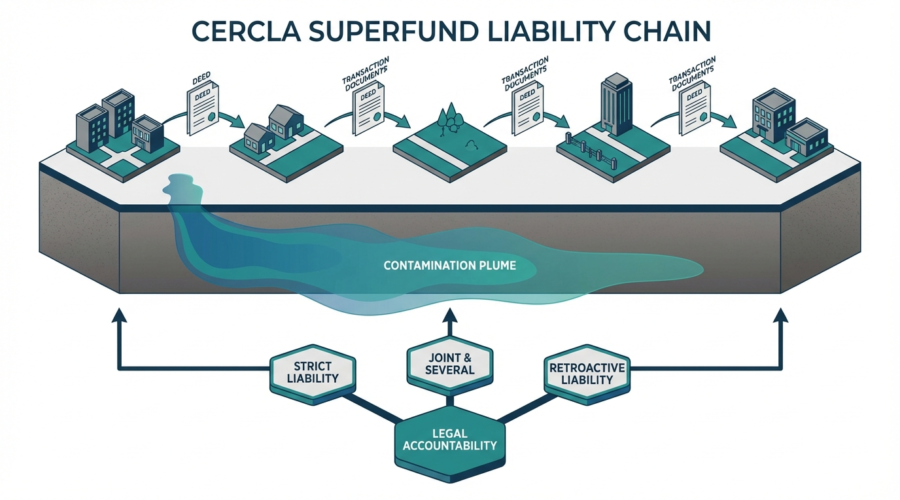
Note the first category: current owners and operators. If you purchase a commercial property in Dallas or Fort Worth that has subsurface contamination from historical operations, you are a current owner — and you are a PRP under CERCLA — regardless of when the contamination occurred, regardless of whether you knew about it, and regardless of whether you had anything to do with it.
The Three Pillars of CERCLA Liability
Strict Liability
CERCLA imposes strict liability, meaning liability exists regardless of fault or negligence. You don’t have to have been careless. You don’t have to have violated any law. You don’t even have to have known about the contamination. If the conditions are met — hazardous substances, release or threatened release, response costs — liability attaches.
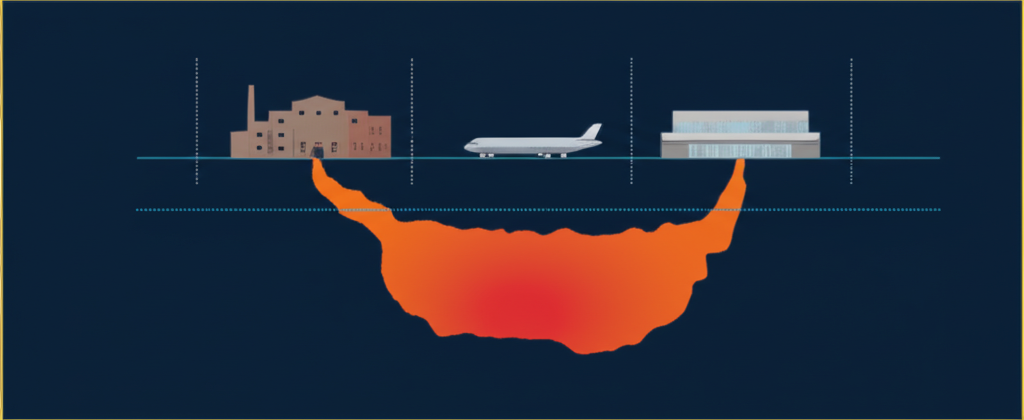
This is fundamentally different from how most people think about legal liability, which typically requires some form of wrongdoing. CERCLA liability requires only ownership or operation.
Joint and Several Liability
When multiple parties are responsible for contamination at a site, CERCLA generally imposes joint and several liability. This means any one PRP can be held liable for the entire cost of cleanup — not just their proportionate share.
The practical implications are significant. If a former dry cleaner, a former auto repair shop, and the current property owner are all PRPs at a contaminated DFW strip mall, EPA (or TCEQ) can pursue any one of them — or all of them — for 100% of the remediation costs. If the former tenants are defunct corporations or judgment-proof individuals, the current owner may be left holding the entire bill. The legal right to seek contribution from other PRPs exists in theory; collecting it in practice is often impossible.
Retroactive Liability
CERCLA reaches backward in time. Activities that were perfectly legal — standard business practices, in fact — in 1965 can create CERCLA liability today. A manufacturing facility that disposed of solvents through floor drains in the 1960s, fully consistent with the regulatory requirements (or lack thereof) at that time, created contamination for which the current property owner can be held liable in 2026.
The retroactive nature of CERCLA is why pre-1980 industrial and manufacturing use of a property is such an important risk factor in Phase I assessments. The law was designed to address contamination that predated modern environmental regulation — which means some of the highest-risk properties are those with the longest industrial histories.
The Defenses That Actually Matter
CERCLA does provide liability defenses, but they are narrow and heavily conditioned. For commercial property buyers in Texas, the relevant defenses are:

The Innocent Landowner Defense
A buyer who acquires property without knowledge of the contamination, and who conducted All Appropriate Inquiries (AAI) prior to acquisition, may qualify for the innocent landowner defense. This defense requires:
- The buyer conducted AAI in accordance with 40 CFR Part 312 (satisfied by a compliant Phase I ESA under ASTM E1527-21) at or before the time of acquisition
- The buyer had no actual knowledge of the contamination at the time of purchase (which means the Phase I cannot identify the contamination — if it does, the innocent landowner defense is gone)
- After discovery of the contamination, the buyer exercised appropriate care to stop the release, prevent future releases, and cooperate with response actions
The key point: the innocent landowner defense requires both a compliant Phase I and no knowledge. A buyer who does a Phase I, discovers contamination, and closes anyway has actual knowledge — and loses the defense entirely.
The Bona Fide Prospective Purchaser Defense
For buyers who are aware of contamination at the time of purchase (often the case in brownfield transactions), the bona fide prospective purchaser (BFPP) defense may apply. This defense requires:
- The buyer conducted AAI prior to acquisition (compliant Phase I)
- All contamination was discovered through the AAI process
- The buyer provides all legally required notices
- The buyer exercises appropriate care with respect to the contamination
- The buyer cooperates with government response actions
- The buyer is not affiliated with any other PRP
- The buyer complies with any institutional controls at the property
The BFPP defense is the legal mechanism that makes brownfield redevelopment possible — it allows buyers to acquire contaminated properties with knowledge of the contamination and still maintain a defense to CERCLA liability, provided they meet all requirements and cooperate with regulatory cleanup programs.
The Contiguous Property Owner Defense
A property owner whose land is contaminated by releases from an adjacent property — not from their own operations — may qualify for the contiguous property owner defense. Requirements are similar to the innocent landowner defense: AAI conducted prior to acquisition, no knowledge of contamination at time of purchase, and appropriate care taken after discovery.
How Texas Programs Interact with CERCLA
Texas has developed two state-level programs that interact significantly with CERCLA liability for contaminated commercial properties: the Voluntary Cleanup Program (VCP) and the Innocent Owner/Operator (IOP) program. Both are administered by TCEQ.
TCEQ Voluntary Cleanup Program (VCP)
The VCP allows current or prospective property owners to voluntarily investigate and remediate contamination under TCEQ oversight in exchange for a Certificate of Completion — a state-issued document confirming that cleanup has met applicable standards. The Certificate of Completion provides:
- Liability protection under state law — TCEQ will not bring enforcement action against the VCP participant for contamination addressed in the cleanup
- Third-party defense — Participants can use the Certificate of Completion in defense against third-party claims
- Marketable title — Properties that have completed VCP remediation can be sold with documented cleanup history and any applicable institutional controls
The VCP is not free — the applicant pays a fee and is responsible for investigation and remediation costs — but it provides a defined regulatory pathway with a clear endpoint. For brownfield properties in DFW, the VCP is often the most cost-effective route to a remediated property with documented liability protection.
Importantly, the VCP Certificate of Completion does not automatically provide CERCLA protection at the federal level. EPA may separately pursue federal Superfund actions for contamination that meets Superfund criteria. However, TCEQ and EPA have coordination mechanisms, and in practice, TCEQ VCP completion significantly reduces federal enforcement risk.
TCEQ Innocent Owner/Operator Program (IOP)
The IOP provides state-level liability protection specifically for property owners and operators who did not cause or contribute to contamination on their property. To qualify, applicants must demonstrate:
- They did not cause, contribute to, or allow the contamination
- They conducted appropriate inquiry prior to acquisition (AAI)
- They are cooperating with cleanup of the contamination
- They are complying with any applicable institutional controls
The IOP is particularly valuable for current owners of contaminated properties who are dealing with contamination they didn’t create — the contamination from a former tenant, a historical industrial use, or an off-site source. IOP status provides a state-level defense that complements the federal CERCLA defenses discussed above.
The Practical Implications for DFW Commercial Transactions
In the DFW commercial real estate market, the intersection of CERCLA and Texas state law creates several practical implications that should inform every transaction involving older commercial or industrial property:
Due Diligence Period
A Phase I ESA should take three to four weeks minimum for a thorough assessment. Compressed due diligence timelines — common in competitive DFW markets — create real risk because the Phase I cannot be adequately completed in three to five business days. A rushed Phase I that misses a REC doesn’t protect the buyer; it just creates a paper trail that looks like due diligence was done when it wasn’t.
Contract Provisions
Purchase agreements for commercial properties in Texas should include explicit provisions addressing environmental due diligence: the right to terminate based on Phase I findings, the right to extend due diligence for Phase II investigation if warranted, representations and warranties about the seller’s knowledge of environmental conditions, and allocation of liability for pre-closing contamination.
Phase I Currency at Closing
ASTM E1527-21 requires that the Phase I must have been completed within 180 days of acquisition. If the due diligence period extends beyond 180 days, the Phase I must be updated. If market conditions cause a transaction to stall, the Phase I may need to be re-evaluated before closing.
The “Checkbox” Problem
Too many parties in commercial transactions treat the Phase I as a checkbox — something to be procured, received, and filed, with no substantive engagement with its findings. This is how buyers end up with contamination liability they didn’t anticipate. The Phase I findings should be read, understood, and evaluated by the buyer and their legal counsel before closing. RECs that are identified should be addressed — not ignored — before the transaction is finalized.
Phase I Is Your Legal Foundation
The CERCLA liability framework is harsh, intentional, and designed to place the cost of environmental cleanup on the parties closest to the contamination. For commercial property buyers in Texas, the Phase I ESA is the primary mechanism for accessing the legal defenses that protect against that liability.
But the Phase I only works if it’s done right. A Phase I prepared under an outdated standard, by an unqualified consultant, without thorough historical research, doesn’t satisfy AAI — and doesn’t provide the legal protection you’re paying for.
At Vertexium Environmental Solutions, we understand that the Phase I ESA is legal infrastructure, not just an environmental report. Every assessment we deliver is prepared to ASTM E1527-21 standards by a qualified Environmental Professional, and backed by the kind of thorough historical research that actually identifies conditions before they become liability.
Phase I, Phase II, and comprehensive environmental due diligence packages are scoped to the property and investigation requirements.
If you’re acquiring commercial real estate in the DFW Metroplex and want environmental due diligence that actually holds up legally, contact us at vertexiumenv.com/contact.html to discuss your property and timeline.
Need Environmental Due Diligence?
Vertexium Environmental Solutions delivers Phase I ESAs with 2-3 week turnaround, fixed-fee pricing, and PhD-level technical review on every report.
Book a Free Consultation
Dr. Mohamed Elansary
PhD in Environmental Engineering from Texas A&M University-Kingsville. Founder of Vertexium Environmental Solutions, delivering Phase I/II ESAs and environmental due diligence for commercial real estate across the DFW Metroplex.