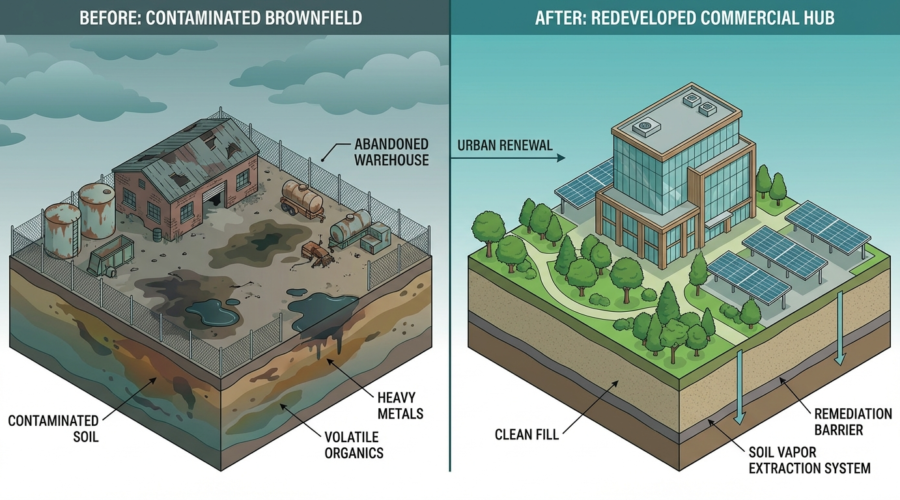
A contaminated property in a prime location, available at a significant discount to comparable clean properties, with existing infrastructure and an established location in a growing urban market: this is the brownfield opportunity. It is also one of the most misunderstood categories in commercial real estate, particularly in markets like Dallas-Fort Worth where redevelopment pressure is intense and buildable land in established locations is increasingly scarce.
Most buyers walk away from contaminated properties. They see a Phase II report showing elevated chlorinated solvent concentrations in groundwater, or a TCEQ LPST case file with decades of remediation history, and assume the liability is unquantifiable and the cleanup costs are bottomless. Some of those assumptions are correct — but many are not. And the buyers who understand the difference between a brownfield that’s manageable and one that isn’t are in a position to acquire properties that their competitors are leaving on the table.
As an ASTM E1527-21 Environmental Professional with a PhD in Environmental Engineering from Texas A&M University-Kingsville, I’ve worked with buyers navigating brownfield acquisitions in DFW — through Phase I identification, Phase II quantification, remediation planning, and TCEQ voluntary cleanup program engagement. This post lays out the framework for understanding when brownfield properties represent genuine investment opportunity and what it takes to capture that opportunity responsibly.
Why Brownfields Trade at a Discount — and Why That Discount Matters
Brownfield properties — defined broadly as commercial or industrial properties where the presence of hazardous substances, pollutants, or contaminants complicates expansion, redevelopment, or reuse — trade at meaningful discounts to comparable uncontaminated properties. This discount reflects several factors:
- Remediation cost uncertainty — Buyers who can’t quantify cleanup costs apply a risk premium that often exceeds the actual expected cost
- Regulatory timeline uncertainty — Not knowing how long TCEQ engagement will take creates a discount that may be disproportionate to the actual delay
- Financing limitations — Properties with known contamination may have limited conventional financing options
- Buyer pool compression — Most buyers walk away from contaminated properties, reducing competition and preserving below-market pricing
- Perceived liability — The CERCLA liability framework scares buyers who don’t understand the available defenses
For a sophisticated buyer who understands how to navigate brownfield transactions — and who commissions the right environmental work to quantify the actual risk — each of these discount factors is manageable. The key is replacing uncertainty with specific, defensible information.
Phase I: Identifying the Opportunity
The brownfield transaction begins, like any commercial real estate acquisition, with a Phase I Environmental Site Assessment. For a known or suspected brownfield, the Phase I has a different purpose than it does for a clean property — it’s not just about identifying whether contamination exists, but about understanding the nature of the contamination well enough to evaluate whether the property is a viable opportunity.
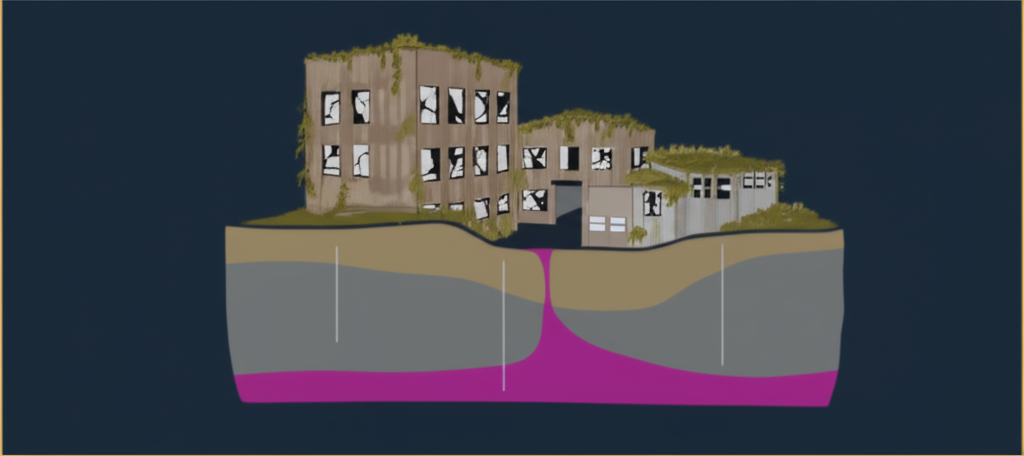
A Phase I on a brownfield should answer:
- What is the documented history of contamination at this property?
- Is there an active TCEQ regulatory program (LPST, VCP, IHW) associated with the site?
- If so, what is the current status and what has been completed?
- What is the likely nature of the contaminants (petroleum, chlorinated solvents, metals)?
- What institutional controls (deed restrictions, groundwater use restrictions, monitoring requirements) are currently in place or required?
- Who are the responsible parties, and what is their current engagement with regulatory requirements?
The Phase I findings don’t make the go/no-go decision for a brownfield — that requires Phase II data. But they define the specific questions that the Phase II investigation needs to answer, and they provide a first-pass assessment of whether the contamination profile is consistent with successful redevelopment.
Phase II: Quantifying the Liability
The Phase II Environmental Site Assessment is where brownfield due diligence gets specific. The Phase II involves collection of soil and groundwater samples — drilling borings, installing monitoring wells, collecting soil gas samples where vapor intrusion is a concern — and laboratory analysis to characterize actual contamination concentrations and extent.
For a brownfield investment decision, the Phase II investigation should be scoped to answer specific questions:
What are the contaminant concentrations and spatial extent?
Phase II results are compared to TCEQ’s Protective Concentration Levels (PCLs), which define cleanup standards for different land use categories (residential, commercial, industrial). A site where concentrations exceed PCLs requires remediation to protect human health and the environment. But the PCL exceedance at a commercial property is evaluated differently than at a residential property — and a site where exceedances are confined to a small area requires less remediation than one with widespread impact.
What is the depth and groundwater condition?
Contamination that is confined to shallow soil above the water table is generally easier and less expensive to address than contamination that has migrated into groundwater. In DFW’s variable geology — Eagle Ford clay in much of Dallas County, Austin Chalk in western Tarrant County — the depth to groundwater, the hydraulic gradient, and the presence of preferential flow paths all affect remediation difficulty and cost.
Is there a pathway to human receptors?
The risk assessment framework underlying TCEQ cleanup standards evaluates contamination relative to actual or potential exposure pathways. If the proposed redevelopment creates a land use that eliminates direct contact exposure pathways (for example, capping contaminated soil with a building slab or parking lot), the required cleanup may be less extensive than for a property with direct soil exposure. Vapor intrusion pathways require separate evaluation.
TCEQ Programs for Brownfield Redevelopment
Texas has developed a suite of programs specifically designed to facilitate brownfield redevelopment. Understanding these programs is essential to evaluating brownfield investment opportunities in DFW.
TCEQ Voluntary Cleanup Program (VCP)
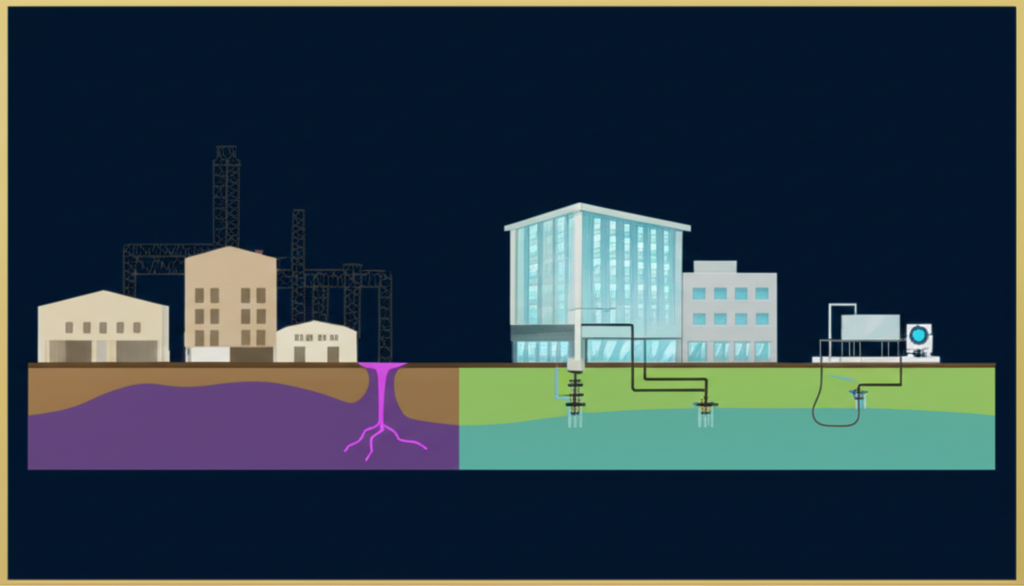
The VCP is the primary regulatory mechanism for brownfield redevelopment in Texas. VCP participants voluntarily investigate and remediate contamination under TCEQ oversight, working toward issuance of a Certificate of Completion — TCEQ’s formal acknowledgment that cleanup has met applicable standards.
Key advantages of the VCP for brownfield redevelopers:
- Defined endpoint — The Certificate of Completion provides a clear regulatory endpoint, unlike open enforcement cases that can be reopened
- Use-specific cleanup standards — VCP cleanup standards are calibrated to the proposed land use, which means commercial/industrial redevelopment typically requires less extensive (and less expensive) cleanup than remediation to residential standards
- Liability protection — TCEQ will not pursue enforcement action against the VCP participant for contamination addressed in the cleanup
- Marketable title — Completed VCP properties can be marketed with documented cleanup history and defined institutional controls
- BFPP protection — Completing VCP supports the Bona Fide Prospective Purchaser defense under CERCLA
The VCP is not free — applicants pay an administrative fee and are responsible for all investigation and remediation costs. But it provides a structured, time-bound pathway to regulatory closure that supports investment planning and exit strategy.
TCEQ Innocent Owner/Operator Program (IOP)
The IOP provides liability protection for property owners who did not cause contamination and who are cooperating with its cleanup. For brownfield investors who acquire contaminated property with pre-existing conditions (not created by their own operations), the IOP can provide a state-level liability shield while the cleanup is ongoing — protecting against third-party claims and TCEQ enforcement action during the remediation period.
EPA Brownfields Grants
EPA’s Brownfields Program provides assessment grants, cleanup grants, and revolving loan funds for brownfield redevelopment. In DFW, local governments — the cities of Dallas, Fort Worth, and several municipalities — have received EPA Brownfields grants and may have programs available to assist private developers with assessment and cleanup costs for properties within their jurisdictions.
EPA Brownfields grants are competitive and have specific eligibility requirements. Nonprofits, local governments, and quasi-governmental entities have broader eligibility than private developers — but private developers working in partnership with eligible entities can sometimes access grant funding through coalition arrangements.
Institutional Controls and Their Role in Redevelopment Pricing
Many brownfield redevelopments are completed not through full remediation to unrestricted use standards, but through a combination of partial cleanup and institutional controls — legal mechanisms that restrict land use to prevent exposure to residual contamination.
Common institutional controls in Texas brownfield transactions include:
- Deed restrictions — Recorded against the property, limiting future land use to commercial or industrial purposes (preventing residential use that would require more stringent cleanup)
- Groundwater use restrictions — Prohibiting extraction of groundwater from the property for consumptive use
- Cap maintenance requirements — Requiring maintenance of engineered caps (building slabs, parking lot surfaces) that prevent direct contact with contaminated soil
- Environmental covenant agreements — Formal agreements with TCEQ defining ongoing monitoring and reporting obligations
Institutional controls must be disclosed in any future property sale and run with the land. For commercial and industrial redevelopment, they typically don’t represent a significant constraint on the development program — but they do represent obligations that must be understood, budgeted for, and disclosed to future buyers.
The Financial Architecture of a Brownfield Deal
Successful brownfield investment requires financial modeling that accounts for environmental costs as explicitly as it accounts for construction, financing, and operating costs. The environmental budget has four components:
Investigation Costs
Phase I and Phase II investigation costs are front-loaded in the transaction. These costs are essential to the investment thesis — they’re what converts “contaminated property with uncertain liability” to “contaminated property with quantified cleanup budget.”
Remediation Costs
Remediation costs are the most variable component and require a site-specific estimate based on Phase II findings. Common remediation approaches in DFW brownfield transactions include:
- Excavation and off-site disposal — Direct, predictable cost; effective for confined soil contamination but expensive for large volumes
- In-situ chemical oxidation (ISCO) — Injection of oxidizing reagents to destroy contaminants in place; effective for chlorinated solvents and petroleum in accessible zones
- Soil vapor extraction (SVE) — Vacuum extraction of volatile contaminants from the unsaturated zone; effective for petroleum and chlorinated solvents in permeable soils
- Monitored natural attenuation (MNA) — Documenting natural biodegradation and dilution processes; lowest active cost but longest timeline
Regulatory Program Costs
VCP administrative fees, monitoring well sampling and reporting, TCEQ agency review time — these costs are modest relative to remediation costs but must be included in the budget.
Contingency
Environmental remediation always carries uncertainty — conditions encountered during cleanup may differ from those characterized during investigation. A 20-30% contingency on estimated remediation costs is standard for brownfield investment underwriting.
DFW’s Brownfield Opportunity Landscape
The most significant brownfield opportunities in the DFW Metroplex are concentrated in the legacy industrial corridors discussed in my earlier post on the DFW environmental landscape — south Dallas, west Dallas, east Fort Worth — where prime urban locations carry contamination that has kept development capital away for decades. As urban land values continue to increase and the supply of clean infill sites decreases, the economic case for brownfield redevelopment in these corridors is strengthening.
The buyers who understand the environmental programs, who commission the right technical work to quantify the actual liability, and who have the patience for the regulatory process are positioned to acquire assets that will look remarkably good in five years. The buyers who assume that contamination means unquantifiable risk will leave those assets for someone else.
Ready to Evaluate a Brownfield Opportunity in DFW?
At Vertexium Environmental Solutions, we specialize in the technical work that makes brownfield investment decisions rational rather than speculative. Our Phase I ESA, Phase II ESA, and Remediation Management services provide the quantified, defensible information you need to underwrite environmental liability with confidence.
We understand TCEQ’s VCP and IOP programs, we know DFW’s geology, and we know how to scope investigations that answer the specific questions brownfield investors need answered — not generic assessments that generate more uncertainty than they resolve.
Contact us at vertexiumenv.com/contact.html to discuss your brownfield opportunity before your competitor does.
Need Environmental Due Diligence?
Vertexium Environmental Solutions delivers Phase I ESAs with 2-3 week turnaround, fixed-fee pricing, and PhD-level technical review on every report.
Book a Free Consultation
Dr. Mohamed Elansary
PhD in Environmental Engineering from Texas A&M University-Kingsville. Founder of Vertexium Environmental Solutions, delivering Phase I/II ESAs and environmental due diligence for commercial real estate across the DFW Metroplex.