The Phase I Environmental Site Assessment is one of the most consistently misunderstood components of commercial real estate due diligence. After conducting Phase I assessments across the Dallas-Fort Worth Metroplex and working with buyers, brokers, and attorneys on the liability implications of their findings, I’ve encountered the same fundamental misconceptions repeatedly — misconceptions that, if uncorrected, can lead to inadequate due diligence, unjustified liability exposure, or both.
This post addresses the five misconceptions I encounter most frequently. Each one has real financial consequences for people who believe it.
Misconception #1: “The Phase I Tests the Soil, So We’ll Know If There’s Contamination”
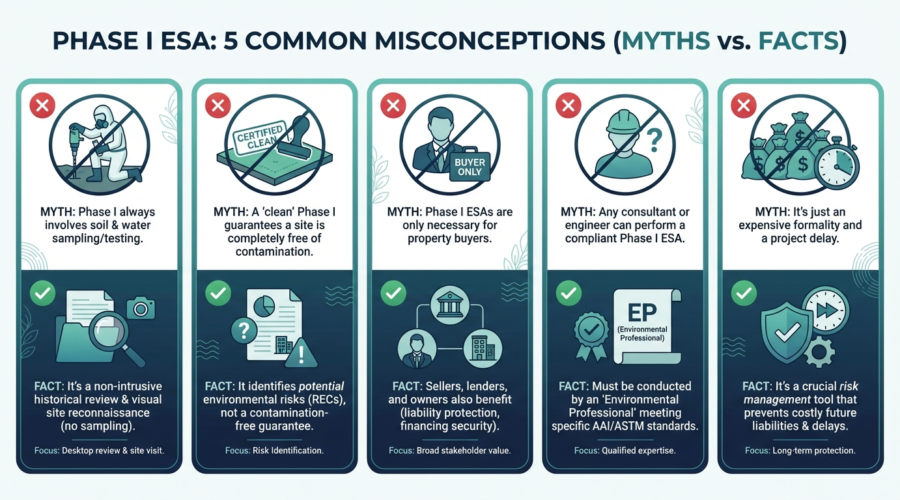
This is the most common and consequential misconception about Phase I ESAs. A Phase I Environmental Site Assessment does not include any sampling. No soil borings. No groundwater samples. No laboratory analysis. Zero physical testing of any kind.
ASTM E1527-21 defines the Phase I as a documentary and visual assessment. It consists of four components:
- Historical records review — Research into the property’s land use history, including aerial photographs, Sanborn maps, city directories, building permits, and historical regulatory records
- Regulatory database review — Search of federal and state databases (TCEQ LPST, IHW, VCP; EPA RCRA, CERCLIS, UST, PFAS) for regulatory actions associated with the property and surrounding area
- Site reconnaissance — A visual inspection of the property’s interior and exterior, looking for physical evidence of potential contamination, hazardous materials, or other recognized environmental conditions
- Interviews — Conversations with the current owner, site manager, and government officials with knowledge of the property
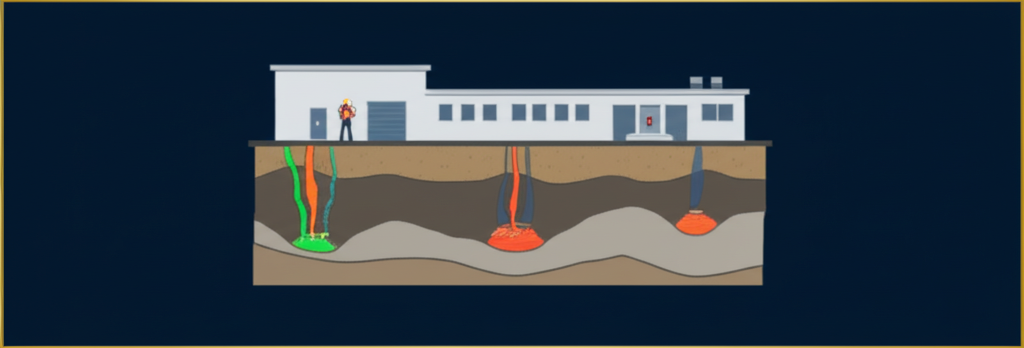
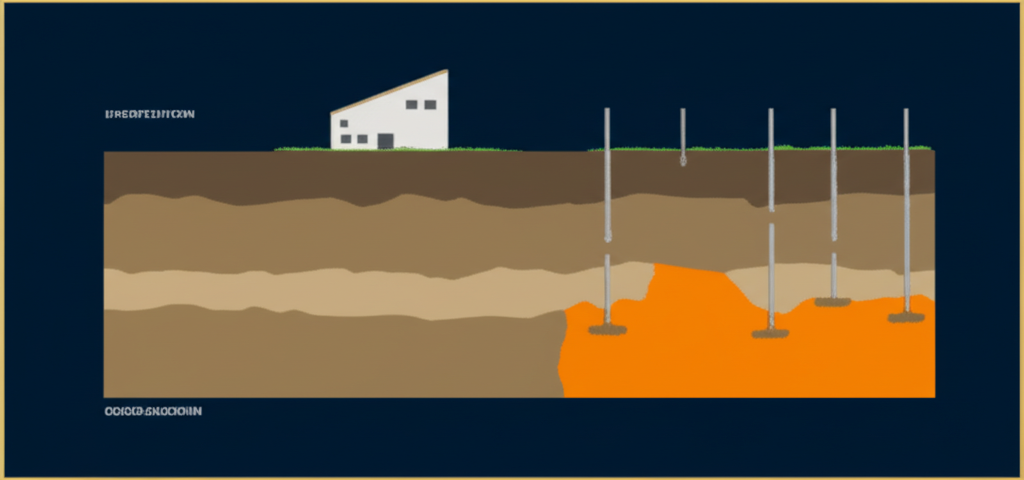
The Phase I can identify conditions that suggest contamination may be present — a former dry cleaner, evidence of a removed UST, regulatory database listings for nearby petroleum releases. What it cannot do is tell you whether contamination actually exists at a specific concentration in a specific location. That requires a Phase II ESA, which does involve sampling and laboratory analysis.
Why this matters
Buyers who believe the Phase I tests the soil have a false sense of security when they receive a Phase I report that identifies no recognized environmental conditions (RECs). A clean Phase I doesn’t mean clean soil. It means the Environmental Professional found no evidence of conditions that would suggest contamination. If the historical research was superficial, if the database searches didn’t identify relevant sites, if the site reconnaissance missed indicators that a more experienced EP would have noticed — the clean Phase I report may be concealing significant contamination that won’t be discovered until someone drills a boring.
Under CERCLA, the buyer who received a clean Phase I and closed on a contaminated property may still have CERCLA liability if the Phase I that established their innocent landowner defense was inadequate. A Phase I that doesn’t satisfy All Appropriate Inquiries (AAI) doesn’t provide the liability protection it was supposed to.
Misconception #2: “No RECs in the Phase I Means No Contamination”
Related to Misconception #1, but worth addressing separately: a Phase I report that identifies no Recognized Environmental Conditions does not guarantee that the property is clean. It means the Environmental Professional found no evidence, through the methods required by ASTM E1527-21, that contamination conditions are likely to exist.
There are several ways that contamination can exist at a property without appearing in a Phase I:
Historical records gaps
For properties developed before the 1960s in many parts of DFW, historical records may be incomplete. City directories have gaps. Sanborn maps coverage is inconsistent for suburban properties. Aerial photographs from the 1940s and 1950s may not be available at sufficient resolution to identify all uses. If the historical record doesn’t document a contaminating use, the Phase I cannot identify it as a REC — but the contamination from that use may still be present in the subsurface.
Regulatory database lags
TCEQ databases are updated on a regular but not continuous basis. A petroleum release that occurred three months ago may not yet appear in the LPST database when the Phase I database search is conducted. A site that was recently entered into the VCP may not yet appear in the VCP database. The Phase I searches the databases as they exist on the date of the search — not as they will exist in six months.
Off-site sources not yet characterized
Contamination from an off-site source — a gas station across the street, a former dry cleaner two properties down — may be migrating toward the subject property through groundwater but may not yet have been documented in a regulatory database or characterized in a way that creates a REC for the subject property. The Phase I evaluates known conditions; it cannot identify conditions that aren’t yet known.
EP limitations
The quality of the Phase I assessment is directly proportional to the competence and diligence of the Environmental Professional who conducts it. An EP who doesn’t recognize that stressed vegetation near a railroad corridor indicates potential arsenic contamination won’t identify that condition as a REC. An EP who doesn’t understand how dry cleaning solvent plumes migrate won’t connect a former dry cleaner two parcels away to a vapor intrusion concern at the subject property. The Phase I is only as good as the person who writes it.
Misconception #3: “Any Environmental Consultant Can Do a Phase I”
This misconception is understandable — the Phase I market has a lot of providers, pricing varies widely, and most reports look similar from the outside. But not all Environmental Professionals are equally qualified, and the qualifications matter significantly for the quality of the assessment and the defensibility of the liability protection it provides.
ASTM E1527-21 and 40 CFR Part 312 define the qualifications for an Environmental Professional (EP) authorized to sign a Phase I report:
- A licensed Professional Engineer or Professional Geologist with environmental experience, OR
- An environmental professional with a relevant degree and three years of experience, OR
- A person with ten years of relevant environmental experience
These are the minimum qualifications. Within this range, the depth of knowledge and practical expertise varies enormously. An EP who has conducted 500 Phase I assessments in the DFW Metroplex, understands the region’s industrial history and geology, and has testified as an expert on Phase I findings in litigation is a fundamentally different product from a recent graduate with two years of experience following a template.
Questions to ask about your EP
- Is the signing EP a licensed Professional Engineer or Professional Geologist? (PE licensure indicates state-board-verified competency and creates personal professional accountability)
- How many Phase I assessments has the EP conducted in DFW specifically?
- Does the EP have specific knowledge of DFW’s geology, industrial history, and TCEQ regulatory programs?
- Will the signing EP personally conduct the site reconnaissance, or will it be delegated to junior staff?
- Can the EP explain how they would evaluate vapor migration from a potential off-site volatile contaminant source?
Price competition in the Phase I market has driven some firms to use junior staff for site reconnaissance, database searches, and report preparation, with a senior EP (or licensed PE) performing only a cursory review before signing. This production model can produce technically compliant reports that nonetheless miss significant conditions — conditions that will become the buyer’s CERCLA liability after closing.
Misconception #4: “The Phase I We Did Two Years Ago Is Still Good”
Phase I ESAs have an explicit shelf life under ASTM E1527-21: the report must reflect conditions as of a date no more than 180 days before the date of property acquisition. This currency requirement exists because the environmental risk profile of a property can change in ways that matter legally and practically:
- New regulatory database entries — a neighboring site that was not in the LPST database two years ago may have been added since the original Phase I was conducted
- Changes in site conditions — new tenants may have introduced new hazardous materials; existing conditions may have changed
- Standard evolution — the current standard (ASTM E1527-21) became effective in February 2023; a Phase I from before that date was prepared under the previous standard (E1527-13), which had different requirements for emerging contaminants and vapor migration evaluation
In practical terms, if your Phase I is more than six months old — for any reason, including transaction delays — you need to either update it or commission a new assessment before closing. A Phase I update is less expensive than a new report but involves having the original EP re-evaluate the report in light of current conditions and databases, potentially conduct a new site visit, and re-certify their conclusions under the current standard.
The standard change issue
Any Phase I conducted before February 14, 2023 was prepared under ASTM E1527-13. Even if the report is within 180 days of acquisition, it may not satisfy AAI under the current E1527-21 standard if it doesn’t address emerging contaminants and vapor migration in the way the 2021 standard requires. For properties where PFAS or vapor intrusion is potentially relevant, an older report may need substantive updating to be defensible as AAI compliance documentation.
Misconception #5: “I Only Need to Worry About My Own Property”
The ASTM E1527-21 standard requires evaluation of off-site sources of contamination — sites within specified search radii that may represent sources of contamination that could migrate to or affect the subject property. This reflects the scientific reality that contamination doesn’t respect property lines.
The most common off-site sources in DFW commercial real estate transactions:
Former Gas Stations
Gas station UST releases are the most common source of petroleum contamination in the DFW market. TCEQ’s LPST database lists the release sites, but the contamination plume extends beyond the gas station property. A dissolved-phase petroleum plume can migrate 200-500 feet or more depending on local hydrogeology. A subject property 300 feet downgraident from a former gas station with an open LPST case may already have measurable petroleum contamination in its groundwater — even though the subject property has no history of petroleum storage.
Former Dry Cleaners
PCE contamination from dry cleaning operations is ubiquitous in DFW strip mall corridors. PCE is a dense non-aqueous phase liquid that sinks through the saturated zone and creates dissolved-phase plumes that migrate with groundwater. Properties adjacent to or downgraident of former dry cleaning operations are at risk for PCE impacts even if they never housed a dry cleaner.
Agricultural Land Use
In northern Collin and Denton counties, former agricultural land uses — including pesticide and herbicide application, on-site fuel storage, and chemical storage — can affect adjacent properties that are now in commercial development. Pesticide residues in shallow soils can migrate through surface water runoff to adjacent parcels.
Railroad Corridors
As discussed in my post on DFW environmental red flags, arsenic contamination from historical railroad herbicide application affects properties adjacent to railroad rights-of-way throughout the Metroplex. This contamination originates off-site but affects the subject property — and it doesn’t appear in standard regulatory database searches because it was never a regulated release.
Getting the Phase I Right from the Start
The five misconceptions addressed in this post have a common theme: the Phase I ESA is not a simple process that produces a simple answer. It is a complex professional assessment that requires qualified expertise, thorough research, appropriate methodology, and current standards compliance to actually deliver the liability protection it is intended to provide.
Commissioning a Phase I should not be a price-optimization exercise. The cost difference between an adequate Phase I and an inadequate one is trivial compared to the cost difference between a clean acquisition and one that carries undiscovered CERCLA liability.
At Vertexium Environmental Solutions, we conduct Phase I Environmental Site Assessments under ASTM E1527-21, with thorough historical research, comprehensive regulatory database review, and professional judgment from an Environmental Professional with doctoral-level environmental engineering expertise. Our reports identify conditions — they don’t miss them.
Phase I ESA pricing is scoped to the property. If you have questions about a specific property or an existing report, contact us at vertexiumenv.com/contact.html and let’s talk through it.
Need Environmental Due Diligence?
Vertexium Environmental Solutions delivers Phase I ESAs with 2-3 week turnaround, fixed-fee pricing, and PhD-level technical review on every report.
Book a Free Consultation
Dr. Mohamed Elansary
PhD in Environmental Engineering from Texas A&M University-Kingsville. Founder of Vertexium Environmental Solutions, delivering Phase I/II ESAs and environmental due diligence for commercial real estate across the DFW Metroplex.